Workout Wednesdays #5

Welcome to the fifth of (hopefully) many Workout Wednesdays. The goal of this column is to create a set of shorter blogs targeted specifically towards providing newer runners with a tangible place to start running beyond just going out to jog a few miles. I do my speed workouts on Wednesday, which is why it made perfect sense to post these workouts in the middle of the week. I find it to be an ideal time a few days after my Monday tempo run and before my Saturday long run, but you can incorporate this into your plan wherever it makes sense. I recommend consuming some sort of nutrition before your workouts – my default is a cold glass of Chia Fresca. If you have a go-to workout that you run regularly and want to share with other readers, please reach out through our contact page to be featured in a future Workout Wednesday.

This workout is a standard interval workout. It begins at a longer distance and as you progress through the sets you start to get shorter and faster. As with every interval workout be sure not to burn out on the first few iterations or the subsequent ones will be all the more difficult. Be disciplined with the rest periods, allow your body enough time to recuperate for the next interval, but no more!

The Workout:

1-2 miles warm-up

2 x 1,000m @ 5k pace w/ 2 minutes of rest

2 x 800m @ 15 seconds faster than 5k pace w/ 90 seconds of rest

2x400m @ 30 seconds faster than 5k pace w/ 60 seconds of rest

1-2 miles cooldown

Now that you’re finished, go down a delicious recovery drink and definitely do not forget to stretch!

Let us know how the workout went and how we can improve in the comments below. Was anything about the workout unclear? If you have a workout you want to share reach out via our contact page and don’t forget to follow the blog to get these delivered straight to your inbox.

Workout Wednesdays #4

Welcome to the fourth of (hopefully) many Workout Wednesdays. The goal of this column is to create a set of shorter blogs targeted specifically towards providing newer runners with a tangible place to start running beyond just going out to jog a few miles. I do my speed workouts on Wednesday, which is why it made perfect sense to post these workouts in the middle of the week. I find it to be an ideal time a few days after my Monday tempo run and before my Saturday long run, but you can incorporate this into your plan wherever it makes sense. I recommend consuming some sort of nutrition before your workouts – my default is a cold glass of Chia Fresca. If you have a go-to workout that you run regularly and want to share with other readers, please reach out through our contact page to be featured in a future Workout Wednesday.

Today’s workout is all about building speed and improving your ability to ascend. Ideally, you want to warm up by jogging to a decently sized hill nearby, but you can always drive to the location and warm up when you get there. Don’t go out too fast on these sprints or you will definitely have trouble at the end. Hills can be deceiving, but integrating an incline-specific workout throughout your training will help you be prepared to tackle them in a race as well as improve your endurance on the flats.

The Workout:

2-3 mile warmup

8×100-200m hill sprints (easy jog back down)

1-2 mile recovery

Now that you’re finished, go down a delicious recovery drink and definitely do not forget to stretch!

Let us know how the workout went and how we can improve in the comments below. Was anything about the workout unclear? If you have a workout you want to share reach out via our contact page and don’t forget to follow the blog to get these delivered straight to your inbox.

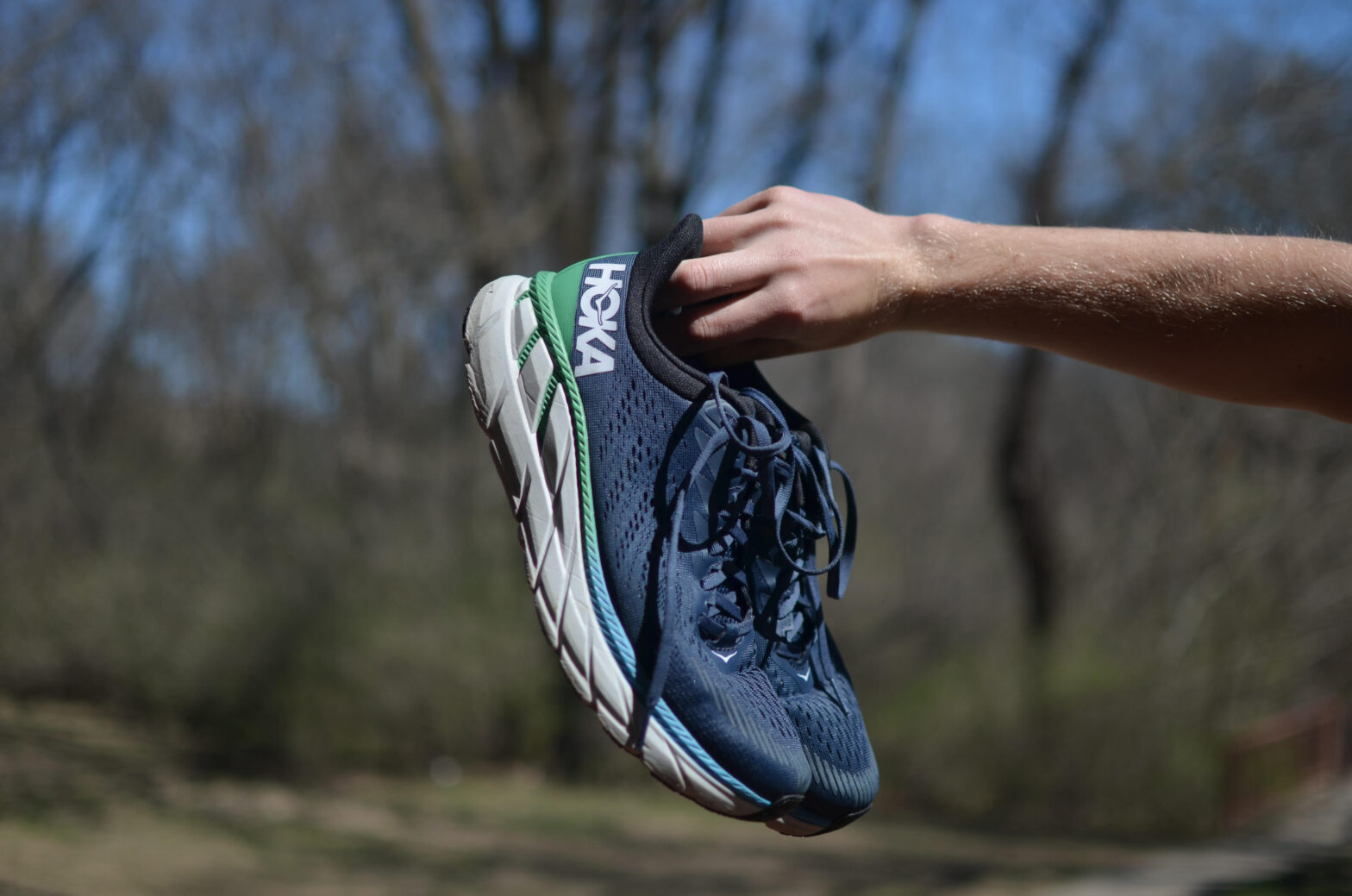
HOKA ONE ONE Clifton 7: 100 Mile Shoe Review

**Disclaimer: I bought these shoes myself and these are my own thoughts and opinions. HOKA ONE ONE will neither preview nor vet this review and I do not receive any compensation from them or from any of the links contained in this post**

I feel like I’m both late to the party and unwittingly cliché in writing this, but I feel obligated to post a review of the HOKA ONE ONE Clifton 7. Originally my first shoe review was going to be of the Atreyu Running Company’s standard colorway because their mission and business model fascinate me. But between a winter slump in running and a tendency to gravitate towards the Clifton 7 (and a few other shoes in my rotation) I haven’t put enough miles into them to write a thorough review. That said, I’ve put about 107 miles on my Clifton’s at this point and it’s time to explain why they’ve recently become my favorite shoe.

The Bottom Line: HOKA ONE ONE has built its brand on max-cushioned running shoes and its flagship everyday trainer is no deviation from the norm. The Clifton 7 is a near flawless go-to shoe built for long miles and ultimate joint/tendon protection that can find itself at home in almost every runner’s closet.

Let’s get the basics out of the way.

Price: $129.95 at Running Warehouse

Designed Purpose: Everyday Trainer

Stack Height: 29mm (5mm drop)

Weight: 9.1 oz (size M9.5)

Fit: True to size

I ordered the Clifton 7’s a while back because of the hype from several running YouTubers and because I was looking to build out my rotation with a more cushioned shoe. This, of course, is HOKA’s forte. I was initially torn between the Clifton 7 and the Rincon 2, but the decision came down to the fact that I already had a pretty reliable everyday trainer in the Brooks Launch 6. Both the Clifton and the Rincon are categorized as everyday trainers, but the Rincon is a “light” everyday trainer while the Clifton is a regular everyday trainer. I usually prefer lighter shoes, but because my plan was for this pair to be a recovery/easy day shoe I went with the Clifton’s.

As an aside, HOKA ONE ONE also makes a cushioned everyday trainer, the Bondi, but as I mentioned before I prefer lighter, less structured shoes in general. If you need a lot of cushion (and I mean a LOT), the Bondi might be a better shoe for you.

I started off running in the Clifton 7’s on my recovery/easy days and found myself edging faster and faster on those runs. Not surprising, considering the shoe is an everyday trainer, but I swear HOKA ONE ONE engineered it to make you want to run faster. Part of this can be attributed to its unique slope on the bottom which gives you the feeling of rocking forward and propels each step forwards with minimal effort. That’s not to say you’ll automatically be faster in these shoes, but they certainly make it easier to work hard.

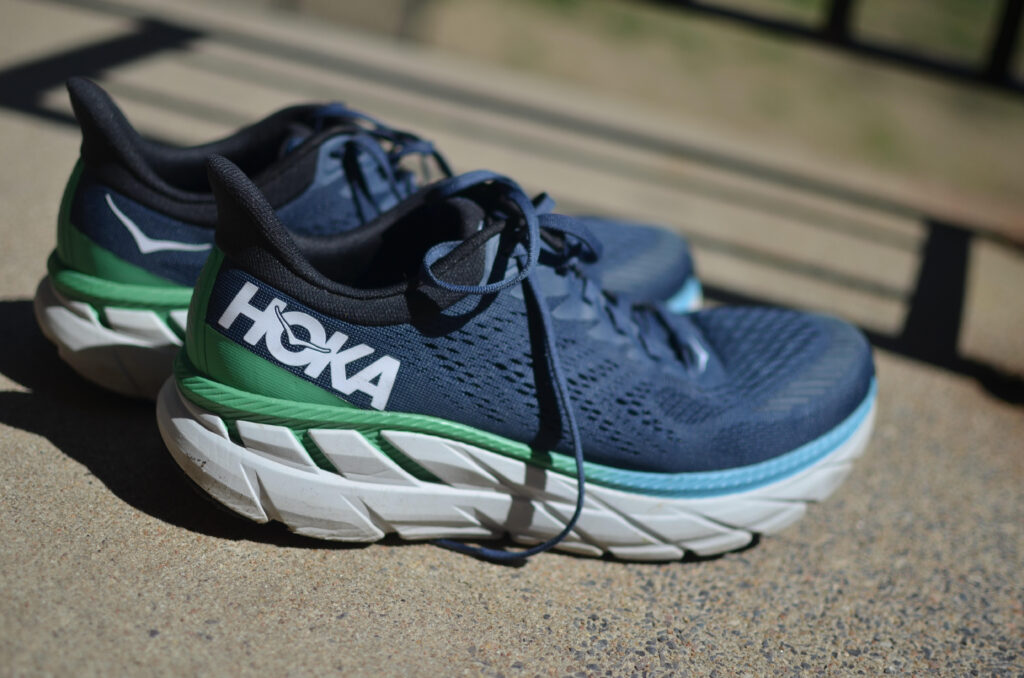
Clifton 7
The Clifton 7’s mesh upper provides breathability and the EVA foam sole creates HOKA ONE ONE’s signature cushioned glide.

The 7 didn’t change much from its beloved predecessor, but most of the changes are for the better. After a few relatively poor attempts in the middle iterations, HOKA is just refining things now. The shoe is light. It comes in at just 9.1 oz in my size (M9.5) which is phenomenal considering the amount of cushion the Clifton brings to the table. In fact, I was in disbelief when I first picked it up after having only seen pictures online. The sole is made from EVA foam (ethylene-vinyl acetate for those who care), which creates the illusion of landing on a padded surface with every step.

The mesh-upper is perfect. It’s breathable and comfortable. The gusseted tongue (fastened to the insides of the shoe) doesn’t move at all, which means that once you’ve put your shoes on and tied them as tight as you want them the shoe won’t move around on you. In fact, I’ve never gotten a blister in the Clifton 7’s. While I’ve heard of some people’s laces becoming untied mid-run because of HOKA’s propensity to make them incredibly slick, this has never happened to me personally – although it’s worth noting my longest run in the shoe was only about an hour.

I can see these shoes going between 300-400 miles without a significant decline in performance. I’ve seen some people, however, taking them out for more than double that distance. One twitter user posted recently that he logged 950 miles on his pair before they became unwearable!

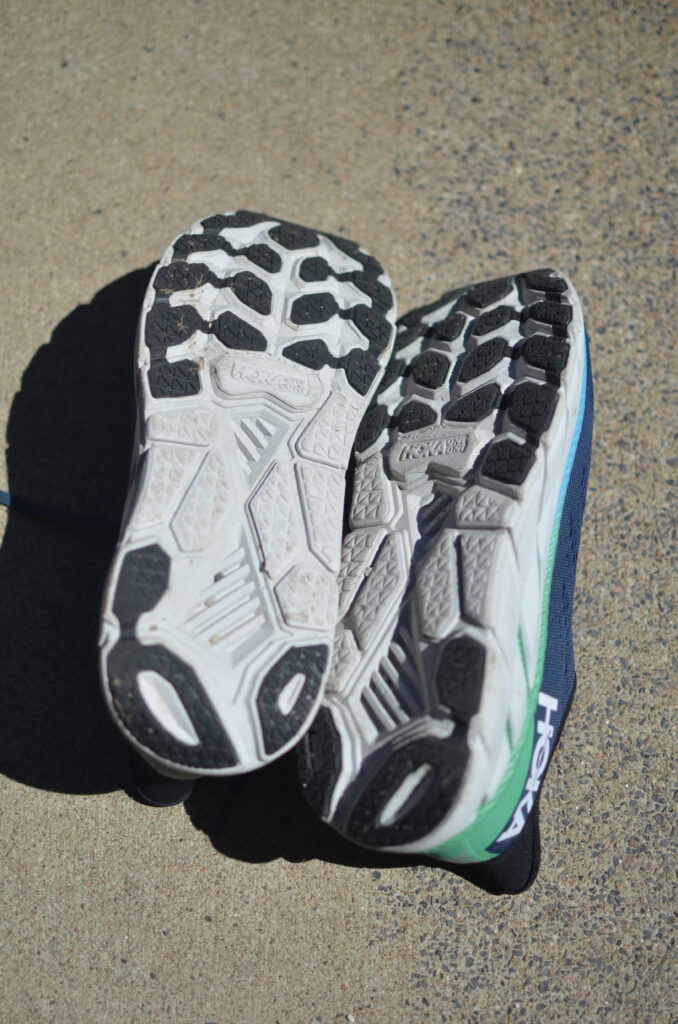
clifton 8 bottoms
After 107 miles there isn’t much wear and tear on the Clifton 7’s.

It’s hard to find much wrong with the Clifton 7’s. That said, probably my biggest complaint is the omission of the iconic pull-tab. Instead we’re left with a weird curl that doesn’t help at all when putting the shoe on. Not everyone likes pull-tabs – and maybe that’s where HOKA is shaving down weight – but personally I love having them. It looks cool and is legitimately useful.

Overall Ranking: 9.1/10

Should you drop everything and go buy the Clifton 7? If you’re already in the market for a new everyday trainer, and you aren’t 100% committed to minimalist shoes, I have to recommend giving it a try. I personally lean away from the max-cushion end of the spectrum, but the Clifton 7’s weight (or lack thereof) certainly makes up for it. This shoe is perfect for someone who is worried about impact on their joints, either from previous injury or the inescapable effects of aging. I often shift to my pair of Clifton’s as a prevention measure when I don’t feel like I’m at 100%. At about 130 dollars it’s not the cheapest pair of shoes, but it won’t break the bank as much as some other pairs will. If you’re worried about stretching your lunch money thin, consider buying the Clifton 6. It’s almost the same shoe and you can usually find the previous iteration of a running shoe at a reasonably discounted price. Plus, you get a pull-tab.

Have you run in the HOKA ONE ONE Clifton 7’s? If so, what’s your take on the shoe? Comment below to let us know what your go-to trainer is and which shoes we should review next!

The Subtle Joys of Running in the Rain

Running is a beautiful sport and there are countless reasons why I and so many others love doing it. From short bursts of speed to methodically paced and drawn out long runs, running offers so much variety for a sport that provides consistency for so many athletes. Among this plethora of variables is, of course, the weather; that unyielding foe whose wrath or favor affects all runners indiscriminately.

I’ve long been perplexed by those who refuse, or hate, running in the rain. Certainly not all rain is suitable for running – and there are ways around this – but unless you live in the extreme corners of the world, or it happens to be the darkest weeks of winter, rain can be a wonderful change of pace for the runner.

It’s recently become warm enough to run regardless of the weather (though I hope I’m not jinxing it by writing this) where I live. We enjoyed a week or two of beautiful, sunny days, during which running was the obvious choice of activity. The last week or so, however, has been dreary and overcast – the kind of weather that makes you want to curl up on the couch with a good book and a warm drink.

Fortunately, I willed myself to get outside (the rising temperatures helped quite a bit) and get my runs in despite the weather. This is when I remembered that rain, so easily a reason for an impromptu rest day, is, ironically, one of the most enjoyable conditions in which to run. It’s a weird feeling, but charging through the rain makes me giddy and seems to boost my motivation and energy. It reminds me of when I was just starting to run as a kid and my grandpa gave me the very helpful advice to “run between the raindrops.” This seemed to be one of many tricks up his sleeve (he was a 2:40 marathoner back in the ‘70s).

But there’s also something rather primitive about running in the rain. It feels like a return to the roots in some ways, a stripping down of our obsessions with pacing, racing, and heartrate zones. It brings forth images of the ancients hunting antelope on foot through the savannah, or the Tarahumara tribe bounding fifty or a hundred miles at a time through the Copper Canyons of Mexico. It’s a shortcut to the “flow” or runner’s high that one experiences on a long, hard run during which, it seems, it’s just you, the path ahead, and the distance yet to be run.

Of course, not every rainy day run is a transcendental experience, but once I get going I find these runs easier to stay motivated for and more enjoyable than the average workout. I know the rain isn’t for everyone, and I get that different folks have different reasons for avoiding it. But next time you’re tempted to hit the treadmill instead of the road because it’s a little wet out, try to embrace the rain instead of avoiding it. If it’s chilly, throw on an extra layer. If the rain gets in your eyes, try wearing a hat. You might hate it, but you might find a new level of enjoyment in the sport we all love (and sometimes hate).

Are you a rainy run hater or embracer? If you’re not a fan, let us know in the comments and maybe give it another shot on the next rainy day. Otherwise, let us know why you enjoy running in the rain (even if it’s only occasionally).

Workout Wednesdays #3

Welcome to the third of (hopefully) many Workout Wednesdays. The goal of this column is to create a set of shorter blogs targeted specifically towards providing newer runners with a tangible place to start running beyond just going out to jog a few miles. I do my speed workouts on Wednesday, which is why it made perfect sense to post these workouts in the middle of the week. I find it to be an ideal time a few days after my Monday tempo run and before my Saturday long run, but you can incorporate this into your plan wherever it makes sense. I recommend consuming some sort of nutrition before your workouts – my default is a cold glass of Chia Fresca. If you have a go-to workout that you run regularly and want to share with other readers, please reach out through our contact page to be featured in a future Workout Wednesday.

This workout is meant to be nested in your weekly long run. The idea is to get your body used to running at faster paces over a longer period, which is why this workout is spent alternating every mile between a fast pace and a recovery pace. Ensure to focus on quality throughout both the easy and hard miles. An easy way to do keep track of your pace is to remember that the slow miles are just a minute slower than your fast miles, i.e. running 7:30 for one mile and 8:30 for the next.

The Workout:

~1-mile warmup

4-7 miles (or longer) alternating between 5K pace + 45 seconds and 5K + 1:45 pace every mile

~1-mile cool down

Now that you’re finished, go down a delicious recovery drink and definitely do not forget to stretch!

Let us know how the workout went and how we can improve in the comments below. Was anything about the workout unclear? If you have a workout you want to share reach out via our contact page and don’t forget to follow the blog to get these delivered straight to your inbox.

How To Build Your Running Baseline (And Why it’s Important)

A few weeks ago, I started working on several articles that dealt with how training pace/effort impacts training outcome. These were focused on combatting our tendencies to run too slow on faster runs and too fast on slower runs. As I was doing research and thinking through how I wanted to approach the subject, I realized that most runners – unless you belong to a team or club, or run at the elite level – don’t have much of an accurate reference point for their training.

I’m talking, of course, about building a running baseline from which you can derive how fast a specific run should be for your skill level. Most workouts are not prescribed just for distance, but place an emphasis on the relative speed. For example, in the first Workout Wednesdays I posted the pace was 30 seconds faster than 5K pace. But this raises an immediate problem if you don’t know what your specific 5K pace is.

Another issue is how can you track progress accurately if you don’t really know where you started? Of course you might start to notice that your times for certain distances start to drop and efforts become easier, but this is hardly an accurate, quantifiable way to track improvements.

It’s important to create and maintain a standardized baseline for your training. You want to get a sense of your max effort across multiple distances, which will help you build a picture of your aerobic and anaerobic fitness and, subsequently, help you tailor your training to meet your specific goals.

This doesn’t have to be complicated or difficult. Personally, I try to run time trials for my 1 mile, 5K, and 5 mile distances every 2-3 months. This helps me to be able to see where I am improving, where I am stagnating, and where I am declining in performance. Time trials are even more important after a period of drastic change in your training. After I had Covid-19 in January I found that my mile was about 30 seconds slower and my 5K was about a minute and a half slower than the last time I trialed those distances in November.

Building a baseline, or conducting a time trial, doesn’t have to be much of a deviation from your regular training. I usually run my tempo runs on Monday, so I try to do my 5K and 5 mile time trials on those days. Wednesdays are my speed workout days, so that is when I try to slip a race-pace mile in. The key is, essentially, not losing sight of where you are at physically so that you can maximize effort on every run. How can you run at a target pace derived from a given pace if you aren’t sure what that given pace is?

As a side note, another way to combat this is to do all your training based on heartrate zones. This is an easy way to train a little bit more accurately if you don’t already have a baseline. Unfortunately, at least in my experience, most workouts are prescribed based on pace and not heartrate (though there is an emerging body of literature that argues for heartrate-based training over pace-based training).

At the end of the day, it certainly behooves the runner to know where they stand at several common distances. For those who lean more towards heartrate-based training it at least helps to be able to track progress. Do you have an established baseline? If so, how often and what distances do you track? If not, how do you see yourself implementing time trialing into your current training plan?

If you liked this article, check out: What Happens When You Don’t Run.

The Dastardly Implications of Running Too Slow

Last week I posted a blog article called The Dastardly Implications of Running Too Fast. The post was mostly concerned with ensuring your easy and recovery runs remain easy and recovery runs. These duel articles are meant to address two of the biggest pacing issues in running: running too fast on slow runs and running too slow on fast runs.

It can be confusing to know how fast to run when you’re just getting into running. Even experienced runners question whether they are running too slow, or if their pace is correct for their workout, and unless you’ve been paying conscious attention, you are probably running either too fast or too slow on your runs. While it is important to understand the differences in specific fast workouts and specific slow workouts, both articles focus on fast and slow more generally. Stay tuned in the future for more targeted posts about specific workout categories.

The obvious goal of running fast is to be able to run faster over time. But this can get complicated when distances become longer and when pacing becomes more important. A 6:50 minute pace isn’t necessarily that fast for a single mile, but if you can hold it for twenty-six of them then you’ll earn your ticket to Boston. It’s important to understand the difference between going out for a good run and specifically running fast to get faster.

There are a few different kinds of fast workouts, but two of the most basic are intervals and tempo runs. Intervals – as you probably already know – consist of a period of intense exercise followed by a longer period of rest. This can be a walking or a slow jog, like in this great half-marathon workout. Tempo runs, on the other hand, are usually a 4-8 mile run at a pace ~30-45 seconds slower than your 5K pace.

By the way, a lot of workouts are prescribed relative to your 5K pace so it’s usually a good idea to run the distance at max effort every now and then.

The problem a lot of people have with these types of faster workouts is that they too often run too slow. There are usually several reasons for this, the first of which has to do with discipline. It takes a lot of discipline to maintain a fast pace over a significant span of time. Often it gets extremely difficult to maintain a consistent effort on every interval. The same is true of tempo workouts. It’s easy to maintain slower-than-5K pace for the first 3.1 miles. It’s when you get up to the fourth or fifth mile that it becomes a workout and a mental game.

Sometimes runners think they’re on-pace, but they really are just missing a piece of information. It’s important to understand the pace at which you’re supposed to be running, whether it’s 100% effort on a sprint or 10 seconds over 5K pace. This means reading and understanding the workout as much as knowing your own body. It’s important to keep your time trials relatively up to date so you can make informed decisions about your pace. This can vary person to person but depending on your levels of training anywhere from every few weeks to every few months is ideal.

At the end of the day, it’s important to run fast on fast days and to run slow on slow days. While the first step in making running a habit is just to get out there and run. to take your fitness to the next level it’s imperative that you understand what a workout is targeting and how fast you need to run to achieve that goal.

Have you been running too slow on your fast days? How about too fast on your slow days? Leave a comment down below to let us know how you keep running fast at the end of a hard workout!

If you liked this article, check out: Crafting Good Goals as a Performance Multiplier in Running.

Workout Wednesdays #2

Welcome to the second of (hopefully) many Workout Wednesdays. The goal of this column is to create a set of shorter blogs targeted specifically towards providing newer runners with a tangible place to start running beyond just going out to jog a few miles. I do my speed workouts on Wednesday, which is why it made perfect sense to post these workouts in the middle of the week. I find it to be an ideal time a few days after my Monday tempo run and before my Saturday long run, but you can incorporate this into your plan wherever it makes sense. I recommend consuming some sort of nutrition before your workouts – my default is a cold glass of Chia Fresca. If you have a go-to workout that you run regularly and want to share with other readers, please reach out through our contact page to be featured in a future Workout Wednesday.

Today’s workout is one of my favorites from my last marathon training block. It can be modified for shorter distances by reducing the number of sets to around 5-7 and running them at 5K pace instead of half marathon pace. Make sure to keep these consistent and don’t go out too hard. The last five are where you will make your money. Try not to walk during the 30-60 seconds of slow jogging (1:30-2:00 for the modification). The key here is making each of the three-minute intervals its own race. It will pay off down the line.

The Workout:

1-2 Miles Warmup

12-15 x 3:00 min @ Half Marathon Pace with 30-60 seconds slow jogging in between.

1-2 Miles Cooldown

Now that you’re finished, go down a delicious recovery drink and definitely do not forget to stretch!

Let us know how the workout went and how we can improve in the comments below. Was anything about the workout unclear? If you have a workout you want to share, reach out via our contact page and don’t forget to follow the blog to get these delivered straight to your inbox.

If you enjoyed this workout, check out: Workout Wednesdays #3.

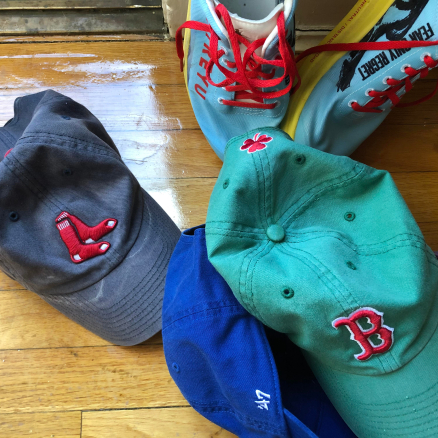
Why I Wear A Hat to Run and Why You (Maybe) Should Too

I have a few hats – eleven of them to be exact. While this isn’t an absurd amount, it is certainly more than one person can wear in a reasonable amount of time. Unless, that is, that person has a near-daily reason to wear a hat. I almost never leave the house for a run without a ballcap. It’s a weird quirk where I feel a little exposed, naked without one. I don’t have a receding hairline or an unusually shaped head, I’ve just gotten used to running with a hat.

There are a few reasons why I always make sure I wear a hat when I’m leaving for a trip that will involve a few runs or when I’m on my way to the track. First, my hat is a thermoregulator. This is just a fancy term that means it helps me stay cool when it’s hot and stay warm when it’s cold. Obviously in sub-zero conditions a ballcap isn’t going to suffice for warmth, but where I live most of the year it doesn’t get that cold. And when it does, I drag myself to the indoor track or pull a beanie on over my ballcap.

When the weather gets hot in the summer, running with a ballcap helps keep me a little bit cooler. I try to wear lighter-colored hats to reflect the sunlight and keep my head cool. This also works the opposite way in the winter (wear dark to absorb the sunlight better). Perhaps more importantly, however, the hat’s headband catches sweat and keeps it from dripping into my eyes while I run.

I have a few hats.

One of the best things about wearing a hat on a sunny day is that it keeps the sun out of your eyes. Sunglasses help too, but a hat can directly block sunlight that creeps through the edges of your lenses. I’m particularly sensitive to bright light so this is a huge help.

Of course, besides the fact that it just feels wrong at this point to run without a hat – that incessant feeling that I’m missing something essential – I just like how it looks. Running with a ballcap has become a small part of my personal identity as a runner. It’s not really unique – there are countless runners who do the exact same thing – but it’s one thing that helps me feel like me when I’m running. Everyone has one or two things they hold on to (whether or not they realize it) that make them feel like themselves. For some people it’s the way they tie their shoes and for others it’s the style of shirt they wear on a run. For me it’s wearing one of my eleven ballcaps, sweat stained and sun faded, for a few miles every day.

Do you wear a hat when you run? What’s your one “thing” that helps you feel like you on a run?

If you liked this article, check out: 50k is the New Marathon.

How To Make Running Long Distances Easier

***This is a guest article written by the Editor-In-Chief at freeFITNESSHUB. They are a Nigerian-based blog whose goal is to help people make informed decisions about their lifestyle and well-being. If you would like to partner with Just Matt Running through guest posts and contributing articles please reach out through our contact page***

These often-neglected tricks can help you become a better distance runner. Try out these techniques if you want to make running long distances easier. These techniques are as simple as they are effective.

Many athletes have asked us how to make running long distances easier. If you become tired easily while running, you may assume immediately that long-distance races are not for you.

The truth is that if you do not have any underlying health issues which impede you from running, you can do long-distance races. All you need is to discover how to make running long distances easier.

Tricks on How to Make Running Long Distances Easier

Without wasting any time, I will immediately go-ahead to give you 5 super tricks that will help you run long distances easily. These tricks are outlined below:

How you Position Your Arm

While running, always keep your arms relaxed and close to your body. Do not cross your arms over in front of your body. If your arms cross over in front of your body while running, this will cause difficulty breathing and also increase blood rotation.

This is because the chest is closed up, thereby affecting breathing. The ripple effect is that you tire-out easily. Therefore, you are advised to keep your arms relaxed and close to your body, ensuring you don’t cross them over in front.

Keep Straight and Maintain a Tall Torso

Keeping your body straight and your torso tall has a magical way of preserving your strength and keeping you running to the finish line. If you maintain this position, you cannot slouch and your bio-mechanics will be thoroughly improved.

This trick is important because it comes to your aid when you are getting tired. Others may start to slouch at this time, but you won’t because this position will increase your energy level.

READ ALSO: 4 Life-Saving Basic Skills in Long Distance Race

Do Not cross Over Your Midline While Running

The proper way to run is to make sure your feet land in line with your hips. Your feet should not cross over your midline. You should align your body position to balance with your feet while running.

It has been observed that crossing the mid-line of your body is an indication that you are not strong enough to embark on the race. To solve this, try to do a body alignment assessment and also engage in warm up exercises before starting any run.

Degree of Hip Extension

You cannot over-emphasize how the degree of hip extension achieved can help you settle the question  “how to make running long distances easier”. The more degree of hip extension achieved while controlling the core, the quicker you are able to run.

Exercises and warm-ups that affect the hips and involve stretches will help you achieve better hip extension. Do this workout at least three minutes before running.

Head position and Focus

The position of your head while running critically affects your running. If you look too far forward, this will unconsciously cause you to lean back and therefore, slow you down. Also, if you look too close, “you’ll be slouching and applying a braking force to your stride.” Ideally you should look around ten – fifteen metres in front.

Foot contact and cadence

The position of your initial foot contact with the ground is vital to effective running technique. The foot contacting the ground in front of the hips leads to an increase in braking forces on landing. This slows you down and increases your risk of injury.

To reduce your stride, you should put some effort into increasing your cadence. Keep your foot relaxed and allow your full foot to contact the ground while running. This allows you to use the best shock absorber there is – the arch of your foot.

Strong stomach

Do you know that maintaining a strong stomach can assist in improving pelvic control and drive for the run gait? Try to keep a stable pelvis. Doing this will help you use the gluteal muscles more efficiently. This will also allow you to wind up your connective tissue. when this is done, the connective tissue will then function as a spring to recoil and drive your leg through to the front using less energy.

TIP: A practical way to improve this strength is to lie on your back, then slowly extend your legs out one at a time. Do this to fatigue 3-5 times.

Arm Swing Balance and Rhythm

Unlike arm swing in sprinting which provides drive, arm swing in endurance running helps you maintain a good balance and rhythm. You should slightly increase your elbow bend at the back of the wing. This will help your elbow to function like a pendulum. The end result is that your running becomes more efficient and you record better results.

TIP: Aim to have a 90-110° elbow bend at the back of the arm swing. Visualize a string attached to the back of your elbow and it being pulled back. Alternatively, imagine squeezing a golf ball in the small of your elbow at the back of the swing.

We’re always here to provide you all the fitness and exercise tips you need. What do you think about this article? Have you tried them out? Share your experiences on how to make running long distances easier. Let us talk about these tricks in the comment section.

***If you enjoyed this article, read more like it on freeFITNESSHUB. Leave a comment down below to let us know if you’d like to see more guest articles and if you have content you’d like to share on the JMR Blog please reach out through our contact page***