A Few Thoughts on Flexibility

I’m 26 days away from my first trail race – my first race, period, of 2022 – and I haven’t done any speedwork. Crap. I haven’t even been on a track in a year because I was in Poland with the Army for most of 2021. My original plan was to build my cardiovascular base in January, work threshold and intervals in February, and ensure I hit my key distances in March. But my training plan, much like life tends to do, got a little off the rails as I navigated early 2022.

Life is Busy

I can be a little obsessive-compulsive about my mileage. I use a combination of Strava data and a handwritten journal to log my runs. My weeks follow a structured outline, and the only significant deviation is distance. Like many runners, I {attempt to} run six days a week; speedwork is on Wednesdays and Saturday is my long run. Monday is reserved for the optional threshold run. The other 3-4 days consist of so-called “garbage miles” or recovery runs.

When I got back to the United States in late 2021, I took an extended break from structured running over the holiday season. In January I got back to it and re-inserted myself into a running plan. The only problem was that I hadn’t factored in a few things. First, I had to remember how to live with human beings in an environment that wasn’t “Work! Work! Work!” all the time. Coming back from overseas – even from a non-combat environment – it is often difficult to reintegrate with family. For nine months you just have to worry about yourself, doing your job well, and calling home every night. I learned very quickly that I had responsibilities to my wife and son that I had forgotten about.

Though my family is incredibly supportive of running, you can’t just dip out for a quick five miles when you have two other people to consider. This did not fit the schedule I kept in Poland where I would get back from work, grab a boxed dinner, and throw my shoes on to pound the pavement for an hour regardless of the time. Back home, working late has consequences. There were a lot of days in January and February in which I had planned to run after work, only to find that I had additional duties to complete and had returned home later than was feasible to run. Dinner only stays warm for so long.

Flexibility can Help

I haven’t unlocked a special secret to running in the business of life. And, unfortunately, it’s not so easy as “just do it,” or, “if it’s important you’ll find time.” I find these mantras to be well-intentioned, but unhelpful. Finding time to run, let alone follow a training schedule, can often feel impossible. Indeed, it requires precision and surgical planning sometimes.

But more than anything, I’ve found, finding time to run and optimizing your training requires a good amount of flexibility. I am not the type of person who easily diverts from the plan. If I miss a workout due to my job or can’t hit my long run because it isn’t conducive to step away for two hours on that particular Saturday I’m prone to just move on and do the next thing.

This works for a while, but when training for a race there are certain blocks to check. My race is twenty miles, so I want to go into having hit at least 70-80% of that distance in training. And, of course, you still have to build up to your 16–18-mile training run. Some will say that speedwork isn’t important for a longer trail race. I would concede that it is less important than, say, a road half-marathon. But speedwork will, quite literally, make you faster and is known to contribute significantly to endurance.

I’ve had a difficult time getting to the track because it is a more time-intensive engagement than getting out the door for a 3–5-mile run. And, as I mentioned earlier, I prefer to do my speed sessions on Wednesdays. But I had the shocking realization that I was racing at the end of the month on a Sunday, which just happened to coincide with my wife planning to spend some time with another mom on the street. So, despite it being a day I don’t normally run, I packed my spikes and drove to the track to hit a quick 8x400m workout (my default speed workout, especially in the early middle of a training cycle). It was a wake-up call both in the respect that I am not as fit as I had hoped {obviously} and that I could still get effective training without holding to my strict day-by-day plan.

Flexibility as a Component of Consistency

Consistency is perhaps the most important aspect of competitive performance over time, but an underrated component of consistency is flexibility. Unless you are a collegiate or professional athlete, hardly will you ever have two hours dedicated every day specifically for training. It is always better to do *something* even if it isn’t what you planned. And it is, likewise, better to hit your key workouts on different days than it is to not hit them at all.

Moving forward, I intend to be more flexible in my training. I will continue to plan diligently and attempt to hold as closely as possible to the workouts, mileages, and specifics of the cycle, but I will also be more comfortable deviating from the plan in order to reach the desired goal. Ultimately, we all must find balance and running is just one of many things we have to figure out how to fit into our busy lives.

If you liked this article, check out: Crafting Good Goals as a Performance Multiplier in Running

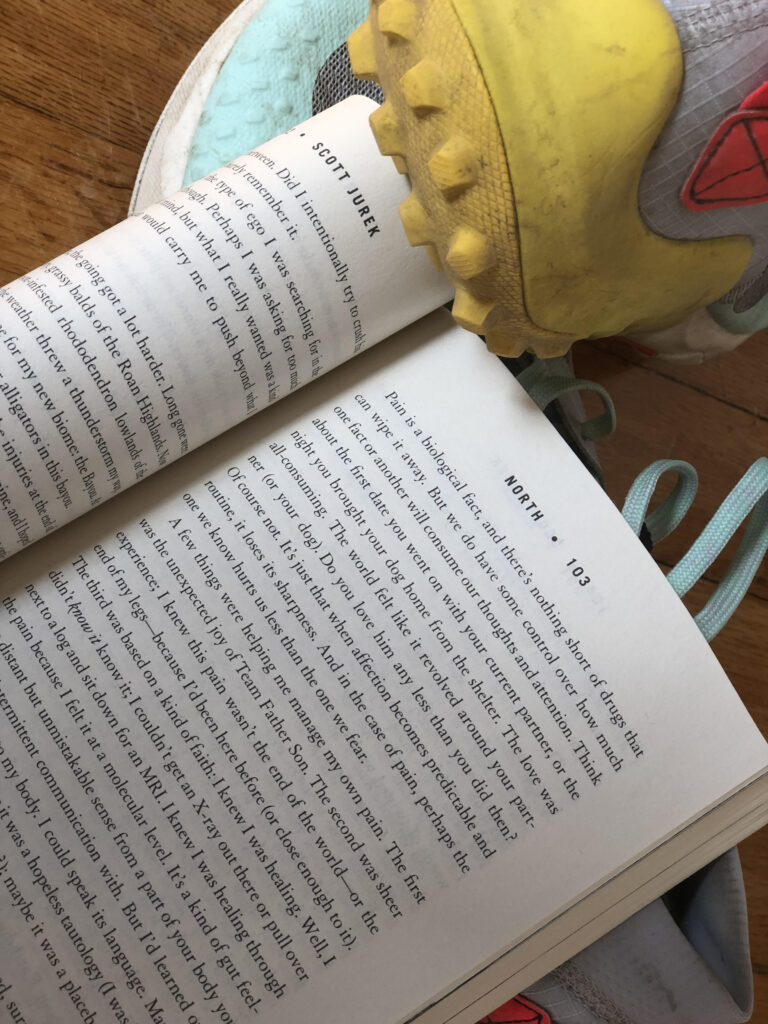
Latest Book Review: North by Scott Jurek
North: Forty-Seven Trail Runs and a Typewriter | Book Review

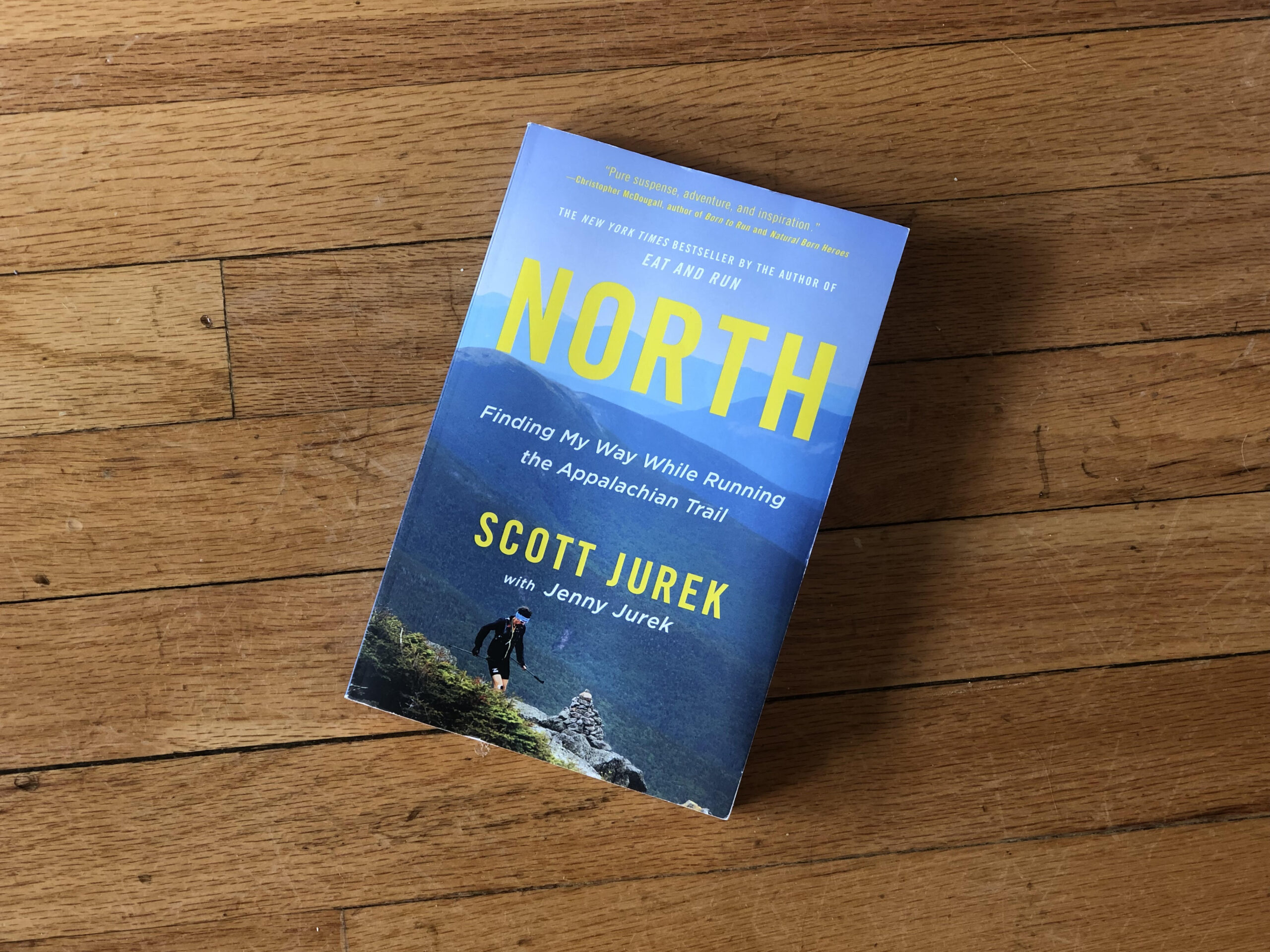
Some books you read for excitement and adventure and some books you read purely for the information they contain. Scott and Jenny Jurek’s North: Finding My Way While Running the Appalachian Trail (2018) is both. While primarily a narrative account of Scott’s attempt to break the fastest known time (FKT) for the Appalachian Trail, it is littered with loads of helpful tips and tricks for trail runners, aspiring and experienced alike. The main reason it stands above others in the genre, however, is because we hear not only from Scott, but also Jenny. It took them 46 days (and six hours and seven minutes, technically) to cover the entire distance of the trail. While Scott was, technically, the one hitting the trail hard, Jenny was the logistical master and leader of the support team; thus, hearing her side of things added another layer of depth to the account.

Examining Jurek’s achievements can lead you to believe that he is an invincible fortress of grit and determination, an unflinchingly tough athlete who doesn’t bleed. In North, Scott rejects this perception and takes the reader inside his strained, desperate quest to conquer the Appalachian Trail FKT. He lays his injuries bare and lets the reader inside every struggle of the attempt. While reading Scott and Jenny’s accounts of the run I kept thinking that what makes this book stand out is their vulnerability. Detailing hamstring and knee injuries is one thing, but the Jureks take us through the ups and downs of their relationships with other runners, other crew members, and each other.

Scott and Jenny Jurek are honest throughout North about just how hard the Appalachian Trail was on their marriage. It wasn’t for lack of effort – they planned to run together every morning, carving out explicit time just for themselves – but forty-six days of waking up at 5 am and running until nearly midnight some nights takes a toll on a relationship. As I said before, what differentiates the book from others in the genre is getting to hear from Jenny every chapter. The two authors have distinct voices and distinct roles in the FKT attempt. Often, we will hear the same story told both from Scott’s perspective and, later, from Jenny’s; or vice versa. One might expect this to get repetitive, but the book is planned so well, and the details of the stories so distinctive in each telling, that it works perfectly. In fact, I left the book looking not only for Eat and Run (Scott’s first book), but also for any other titles Jenny may have written (looking for a mom runner/climber book here in 5-10 years!)

Another treat for readers is all the different characters that pop up throughout the telling of North. Those who have read Born to Run will recognize Luis Escobar, Jenn Shelton, and Billy Barnett. Others familiar with the trail community will enjoy reading about David Horton and Karl Meltzer (the latter of whom broke Jurek’s AT record a few years later – with help from Scott himself). All these people – and many more – pop up throughout the book as members of Scott’s crew for varying durations. Of course, this makes sense given the length of his presence in the trail/ultra-world; Scott is known as much for his friendliness as he is for his feats and accomplishments. In addition to helping Scott complete the Appalachian Trail, his companions add color to the book and make for an incredibly interesting narrative.

Reading North instills in you a burning desire to hit the trails and lay down a few miles.

There’s a great quote from Chris McDougall, regarding why he wrote Born to Run; “Most of the time when you see running depicted, it’s punishment… Yet I know the experience is the exact opposite – it’s fun!” North is its own story, and the Jureks own it. But in a way, it feels like a continuation of Born to Run’s modus operandi. North pulls you into Scott and Jenny’s world, the world of ultra-racing and the world of trail running. It reaches towards the reader, enticing them into the trail world just for a few hours. And, despite the lowest lows that Scott and Jenny have on the trails, it reminds you that, at the end of the day, running is fun. Running is enjoyable. Running is a lifestyle, but it is also something we do to escape the monotony, chase endorphins, and add a bit of enjoyment to our days.

Scott ends the book with a quote from David Horton, “This is who I am. This is what I do.” This is the mindset that carries the Jureks from Springer Mountain to Katahdin, and the mindset that keeps so many runners pushing for consistency and pushing for improvement. North is about Scott Jurek’s Appalachian Trail FKT attempt, but it is also about his transformation and the rekindling of his inner fire. It is about how running brings people together and how we need each other to keep going. It’s a remarkably timeless theme that the Jureks pull, subtly, from their month and half on the trail and weave perfectly through the book.

Ultimately, as one blogger pointed out, reading North is a bit like reading about the Titanic. You know what’s going to happen, but you want to hear the tale of how it reached that point. At the end of North, Scott gets the FKT. But the real story is how they made it happen together, and with the help of everyone around them on the trail. It’s nearly impossible to walk away from the book without the strong urge to dash onto the nearest trails and lay down a few miles. I would recommend it to anyone, regardless of where you are in your running journey. The book is a page-turner and will certainly motivate you to pick your shoes up and turn the doorknob – you will not regret it.

North Rating: 8.2/10

If you liked this article, check out: Once a Runner: An Imperfect Masterpiece

Talking Through My 2022 Goals

Every January, we go through our human, personal ritual of examining the past year and projecting that which we hope to achieve upon the coming twelve months. Like nearly everyone else on the planet, I did the same thing in December and January, hoping to define my road to success for 2022. For the next several paragraphs I hope to outline my goals for the year and, perhaps, inspire you just a bit to pursue your own. It’s worth stating the obvious, that I am writing this at the beginning of February. I’d like to say that this is because I spent a month refining and narrowing down my goals, becoming absolutely sure that this is what I want to achieve, but in reality, life got a little in the way. Despite nailing down four concrete goals I failed to nail my writing schedule in January. A second use, however, of posting a “goals” article in February is by this time each year many of us have given up on our so-called resolutions. I hope to encourage you all to revisit the goals you laid out on December 31st and January 1st and reevaluate how you may or may not be on track to meeting them in 2022.

I have four things I would like to achieve in 2022: Run 1,000 miles, run a sub-3:25 Marathon, run a sub-1:32 Half-Marathon, and run a sub-5:00.00 Mile. Each of these goals was selected because it seemed to be the next logical step in my progression as a runner; another rung in the ladder.

James Clear points out that having goals is one thing and creating systems to achieve those goals is something else entirely. While in some respects I already have a well-established system to help me meet these goals, I will go into a little more detail with respect to what I need to do to achieve each goal. Perhaps this enunciation will help you when thinking about what systems you will need to meet your 2022 Goals.

Running 1,000 Miles

Last year I ran 668 miles. In 2020 I ran 656 miles. The year before that I ran 218 miles. As I’ve written about before, consistency is key to improvement and progression. Over the past several years, it has also been one of the aspects of running I struggle with most. Setting a goal of running 1,000 miles is more than just trying to hit that sleek, four-digit number. I know, just as you probably do instinctively, that I cannot get there without being incredibly consistent. I have to average 83.3 miles per month in order to get to 1,000. That breaks down further to 21 miles every week, or just over four miles daily for 5-day-a-week runners. I usually shoot for six days a week, including long runs, but sometimes I get back late from work or cannot run for other reasons. That said, in the back of my head I would like to get up to 30–40-mile weeks, especially as I get into my Half-Marathon and Marathon training cycles but looking at the historical data it is more realistic for me to set my goal that targets consistency at 21 miles per week. And if I exceed that standard, all the better.

Sub-3:25 Marathon

I’ve run three marathons to date. My first was 4:31, the second was 3:38, and the third was 3:31. While my ultimate mid-range goal is to qualify for the Boston Marathon (sub-3:00, but we all know it’s more like 2:52-2:55 since they cap the number of participants) whittling my time down by six minutes should be a very attainable goal. I also know that my training cycle for last year’s marathon was incredibly convoluted and inconsistent, so I can do a lot better in 2022. A 3:25 Marathon boils down to a 7:49 average per mile. In training, I will be shooting a pace window between 7:30 and 7:45 in order to have a little bit of cushion when it comes time to race. I am currently planning to race in late August but may push back to October depending on how life unfolds for us in 2022.

Sub-1:32 Half-Marathon

While my main focus in running is the Marathon, I planned a Half-Marathon for May 2022 in order to have some speed in the bank going into my Marathon training block. I have not raced 13.1 in years, since before I was a runner, and my time is honestly embarrassing. When I ran the Munich Marathon last year, however, I clocked the first half in about 1:36. I ended up bonking a few miles later, so it wasn’t the greatest plan, but what I learned is that, with some specific training, I should be able to drop 4-6 minutes on my 13.1 to get down to around the 90-minute mark. This works out to a 7:01 pace (1:30 would be 6:52), which I will target in training. My thought process in setting this goal is twofold: to gain experience at the distance and to hold a pace similar to what I would have to hold for my Boston qualifier for 13.1 miles.

Sub-5:00.00 Mile

While the Marathon is glorious in its own right, the Mile is one of the most prominent distances in running. My last timed mile was 5:47, clocked right after I recovered from Covid-19 in early 2021, so I am sure that sometime in 2022 I can drop it down to a low five. My ultimate goal is to run sub-4:30, but getting down to the five-minute mark would be a significant step forward. I plan to run a time trial a month out from my Half-Marathon and a month out from my Marathon. Once I complete my Marathon in August or October I will shift to training specifically for the mile.

I have a few other 2022 goals, such as breaking 18:00.00 in the Thanksgiving 5K, and running my first official Trail 20 Miler in March, but these are the four that I will be focusing intently on throughout the year. As I get closer to each goal, I will post updates with my progress or lack thereof. While it is important to have accountability with someone nearby, you – the running community – are part of my accountability for 2022. I do hope this post has inspired you, at least somewhat, to revisit any of your goals that may have fallen to the wayside in January. I’d love to hear what you’re trying to achieve in 2022, leave a comment down below with your plans!

If you liked this article, check out: Why I Run

Moms Rocked it at the 2022 Houston Marathon

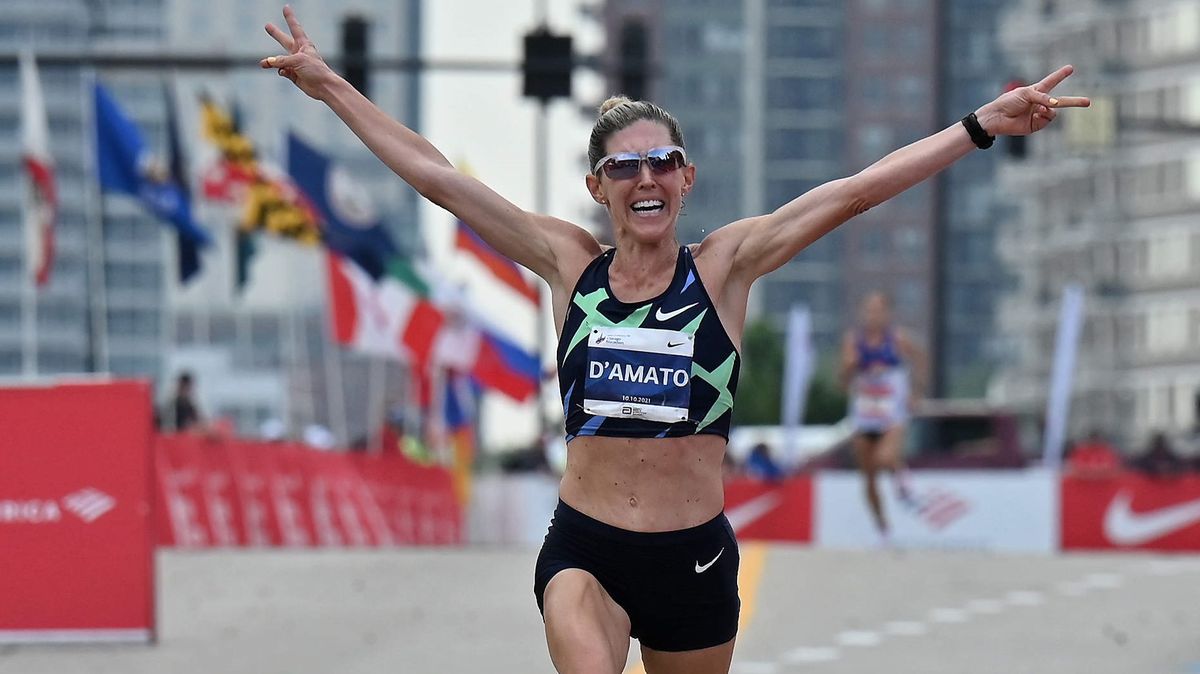
Over the past two years, we have seen an uptick in American marathoning, specifically in the women’s field. This weekend, at the 2022 Houston Marathon, two women – Keira D’Amato and Sara Hall – broke the American Records (AR) for the marathon and the half-marathon, respectively. Perhaps even more significant is the fact that both women are moms.

Keira D’Amato ran 2:19:12 to break the AR in the marathon at 37 years old with two kids. Sara Hall put up 67:15, breaking the AR for the half-marathon at 38 years old with four kids (just over a year after running the second-fastest marathon for an American woman at The Marathon Project). Both women are at the pinnacle of an American distance running movement and are doing so while proving that age is truly just a number and, importantly, that you can be a mom and still crush it out on the pavement.

It’s common knowledge that, in general, the further the distance, the later you peak – at least as far as distance running is concerned. But for most people, this means 28-31. In fact, Chris McDougal writes in Born to Run that people continue accumulating speed (assuming a consistent and diligent training regimen) until they are about 29, at which point their body and performance begin degrading slowly. His point is more so about the longevity of high-performance running – he goes on to say that it would take someone until well into their fifties to degrade to the point they were at when they were 21 – but it also assumes that you don’t have much speed left after you turn 30.

Sara Hall and Keira D’Amato are here to tell us that simply isn’t true. For further reference, D’Amato’s average pace at the 2022 Houston Marathon was 5:19 min/mile. Hall’s pace was 5:08 min/mile for 13.1. Clearly, we have more to discover about the limits of our human condition.

As if their age wasn’t impressive enough, both women are mothers. Anyone who has kids, or was a kid, or knows people who have kids knows that motherhood is an impressive – and time-intensive – thing. No matter if you’re a stay-at-home mom or work full-time, taking care of one, let alone more than one, child is tough work. D’Amato and Hall have shown that it is possible, not only to be a mom and work out but also to excel in competition and reach the pinnacle of your sport.

Keira D’Amato and Sara Hall weren’t the only fast Americans in Houston. Fiona O’Keefe and Emily Durgin both ran sub-68:00 half marathons. One reason this is significant is that before this weekend only four American women had broken the 68-minute barrier (Keira D’Amato is one of those four, running 67:55 last month). In the male field, keep an eye on Frank Lara, who put up a 2:11:32 in his debut marathon, finishing first among Americans and sixth overall, only 29 seconds off the race leader.

No matter how you look at it, the 2022 Houston Marathon was a win for American runners and a win for moms. Keira D’Amato and Sara Hall became America’s fastest runners at ages 37 and 38, all while being full-time mothers. If you’re a mom, now’s the time to be proud of everything you’ve accomplished, no matter how long you’ve been a mother. Otherwise, now is an excellent time to show some appreciation to the mothers in your life.

If you liked this article, check out: What the 2021 Olympic Marathon Says (and doesn’t say) About the Future of American Marathoners

The 4x4x48 Challenge: An Ultramarathon in Bite-Size Pieces

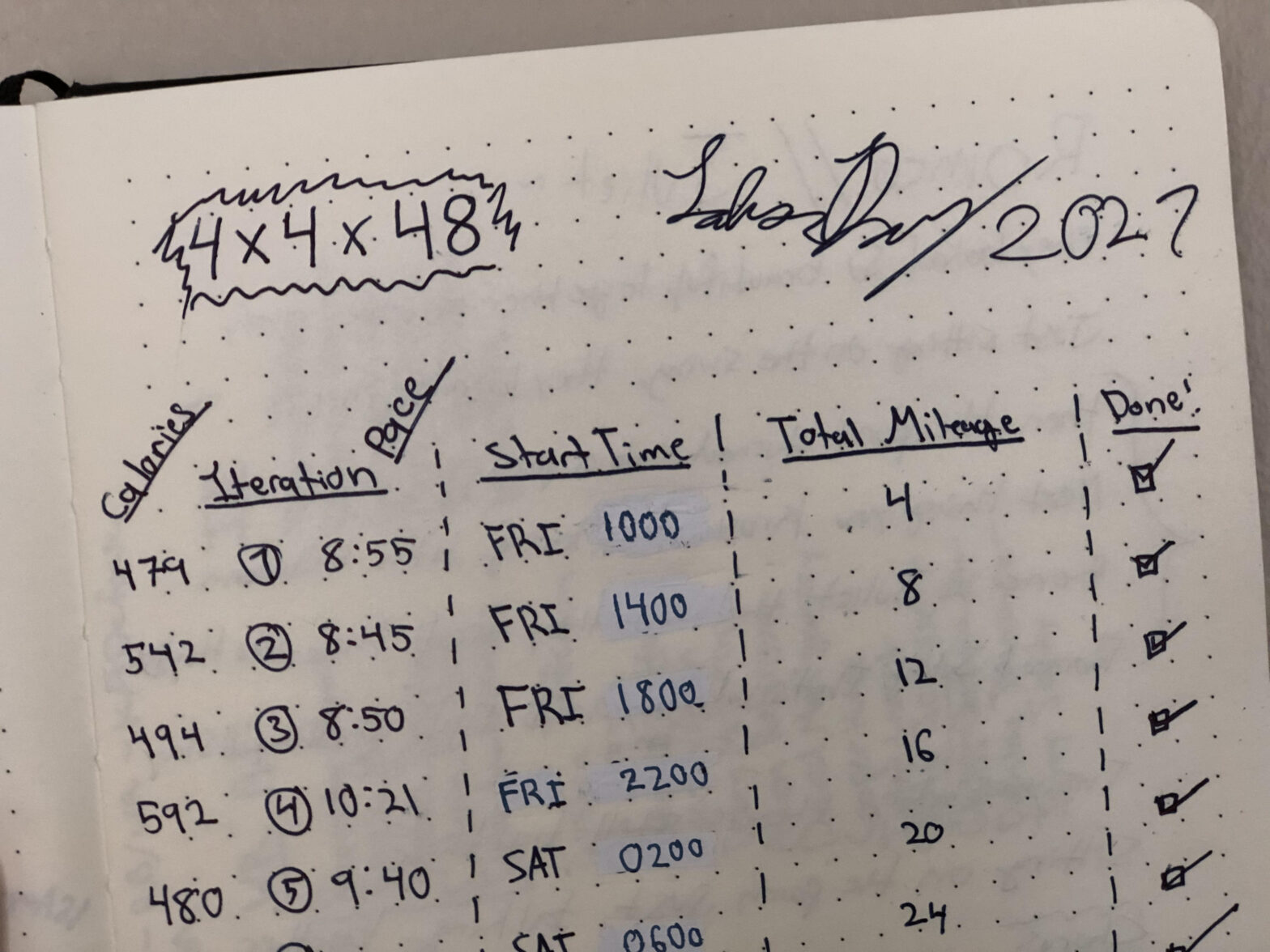
Several months ago, I took it upon myself to complete the 4x4x48 challenge. For the uninitiated, this challenge was created by former Navy SEAL David Goggins to test both physical and mental endurance. It consists of twelve four-mile runs in four-hour increments: four miles every four hours for forty-eight hours. You don’t get much sleep, if any, and, in case you missed it, the challenge adds up to forty-eight total miles. Unofficially, this qualifies it as an ultramarathon (any race – or challenge – longer than the traditional 26.2).

It’s not all terrible. There is no time limit to the runs, so you can technically take up to four hours to complete each four-mile segment. I found that the runs that took place during the day were not incredibly difficult, but the runs in the middle of the night had me questioning all my life choices. Ultimately, I completed the challenge and proceeded to sleep for the next six hours (despite it being about 8 am).

I structured my 4x4x48 challenge such that my runs took place at 6, 10, and 2. This meant that I was able to get some decent sleep during the night portions, my intention was to only have one run that truly interrupted my regular sleep cycle. I had originally planned to start the challenge at 2 pm on Friday, but as the day began I found myself on edge and just anticipating the next 48 hours, so I decided to start at 10 am.

The first few runs (10 am, 2 pm, and 6 pm) were not difficult. I cruised through each of the runs at a comfortable 8:30-9:00 min/mile pace in anticipation of the coming miles. I pinned my headphones to some upbeat music (exclusively emo) and chugged along. After each run I ate half a banana and took a quick shower. I decided beforehand that while I didn’t really want to take twelve showers, it was worth it for my mentality to be clean in the periods where I wasn’t running.

I slept after my 6 pm run and waking up for the first 10 pm run was dreadful. It was about 25 degrees Fahrenheit and pitch black except for the faintly lit street lamps. My legs were like cold molasses – as I had woken them from their regular recovery cycle – and my brain was slow. I trudged through the four miles, desiring desperately to quit and return to my sweet bed. This was when I realized that though the 4x4x48 is certainly a physical challenge, but even more so a mental challenge.

Running four miles is, for most runners, an unremarkable feat. But running four miles every four hours for forty-eight hours is tough on even the most experienced athletes. The challenge prevents your legs from ever fully recovering. It also never allows you to get more than a few hours of sleep at any one time. After the first night, I was a mental jellyfish. I spent the day watching running YouTube videos and preparing psychologically for the next run and, more importantly, the next night.

While my daytime runs on Saturday went without a hitch (I even had several where I finished with a 6:50 mile) I was dreading the coming evening. I had planned to watch a college football game (Go Army Football!) instead of sleeping, but after my 6 pm run, I crashed. I barely woke up for my 10 pm run and didn’t set off until about 10:20. It’s worth mentioning at this point as well that while I kept my paces respectable during the day, all four of my night runs were over 10:00 min/mile averages.

My second 2 am run (and eleventh run overall) was both the hardest mentally and the most optimistic because, once I was finished, I knew I only had one more run left. I woke up at 5:55 am for the last segment of my 4x4x48 challenge to a beautiful sunrise and a crisp 32-degree morning. I knew, at this point, that despite the pain in my legs I was going to finish. When I set out, I had entertained thoughts of making it a six-miler instead of a four-miler so that my total distance would be 50 miles, but after the first fifteen minutes, I was convinced to run only the required length. As I cruised home on the last mile I knew it would be a while before I ran another 4x4x48 challenge.

As I alluded to earlier, the biggest takeaway from the challenge was mental endurance. Most consistent runners will have the leg strength to push through the pain and complete each run. It is the mental aspect that differentiates the successful from the unsuccessful. The night portions were by far the hardest because I just. Wanted. To. Sleep. The challenge didn’t necessarily make me any better physically, but it did teach me to push through uncomfortable moments and painful experiences.

If you have the time (obviously 48 relatively uninterrupted hours) I have to recommend doing this challenge if only to prove to yourself that you can. I started on Friday morning of a weekend where I had no obligations from Friday through Monday. I then had almost all of Sunday and all of Monday for my legs and my sleep to recover. After completing the challenge, I believe you could do it in three days, rather than the four I allotted myself, and be fine to return to your regular activities after your “most of the day” recovery. By the way, if you want to do the challenge along with David Goggins, his next 4x4x48 challenge will be on 4 March 2022 starting at 8 pm PST.

It’s important to do hard things for the sake of doing hard things because it shows you that you do have the capacity to push yourself further than you previously thought. At the end of the day, this is one of many reasons we run: because it challenges us every day to get better, to do what we once thought impossible.

If you liked this article, check out: Run to the Top

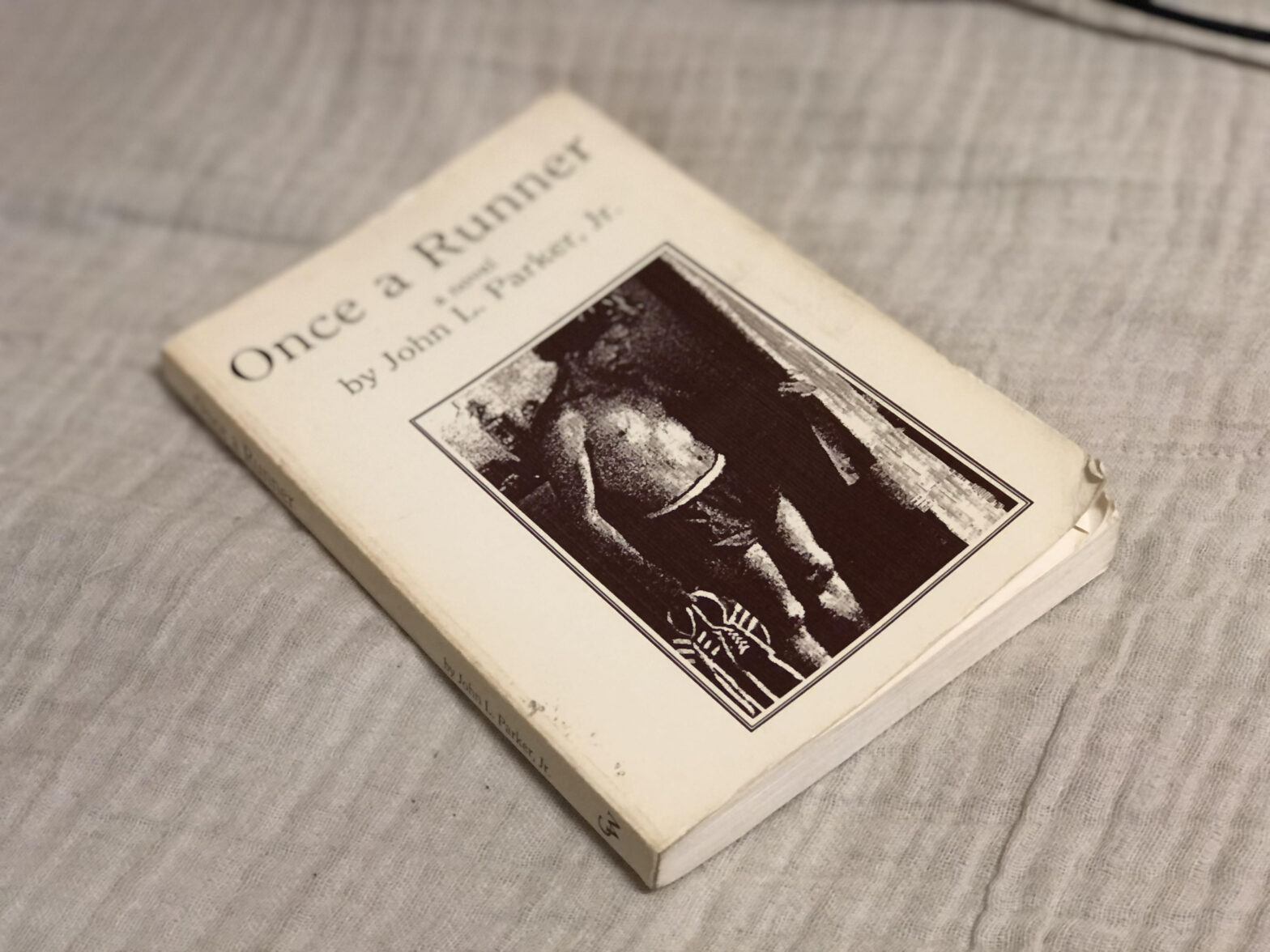
Once a Runner: An Imperfect Masterpiece | Book Review

How do you review a book that so many have read and loved, that’s been dissected and written about for years? I’ve read Once a Runner twice now and gone back and forth on the best approach to take addressing it on the blog. It’s something I want to talk about, but without just repeating the same praises so many others have heaped upon John L. Parker Jr. It’s a damn good book and every runner should read it. It’s the best running fiction to ever grace the bookshelves of aspiring track athletes and collegiate cross country teams. It’s a cult classic, the kind of novel that gets lost in translation; Once a Runner is a book you can’t understand if you’ve never felt the euphoric feeling of flying across the pavement, the trail, or the track, understanding that you’re pushing as hard as you can go but still have miles left in the tank. You might, in fact, be offended by its brusque, dismissive arrogance. But you’ll still love the book.

With that out of the way, if you want to read a classic review of Once a Runner check out Marc Tracy’s commentary on the best novel ever about distance running or Patrick Gibson’s follow-up review in Citius Magazine. If you want to hear all about the book’s shortcomings, a warning to the uninitiated, read Caela Fenton’s takedown in Canadian Running Magazine. But, if you want to know why Once a Runner has been devoured by generations of runners and will always be a powerfully flawed, masterful ode to our sport, read on.

Once a Runner speaks to the hypothetical realization of peak running. Quenton Cassidy, the book’s protagonist, doesn’t represent what every runner should be, but rather what every runner could be. Parker’s novel is littered with countless pieces of wisdom and memorizable phrases such as “a runner was not made by winning a morning workout” that stick with the reader long after they finish the book. He writes about the altar of Consistency, upon which the runner sacrifices daily to improve. Regardless of their level, every athlete who reads this passage can relate; every reader understands the significance of a missed workout or mileage that was never completed.

John L. Parker Jr. didn’t write Once a Runner for everybody, he wrote it for runners. One of the most significant themes that pervade the book is the Trial of Miles; Miles of Trials. This is, perhaps, the most important thing for a runner to understand; something Bruce Denton, Quenton Cassidy’s mentor and friend, imparted to him early on and something he and his partner in crime, Jerry Mizner, try to instill in their younger teammates – those who haven’t quite grasped the commitment and consistency required to become a runner. While most people who read Once a Runner will never run a four-minute mile, or dial in multiple hundred-mile weeks, the Trial of Miles is something every runner understands. You can only get so far on natural talent and grit. Our sport is relentless and unforgiving in its refusal to yield improvements to those who hesitate when it’s raining outside, or the humidity is too high. A runner only improves by running, not by not-running. Parker knows this and, more importantly, he knows that every runner knows this – whether they embrace it or not.

One of the most significant events, albeit only addressed in a few paragraphs, is Jerry Mizner’s ailment that takes him out of the running game for a few months. Sooner or later, almost inevitably, runners will experience injury. Every runner knows it, and smart runners know how to identify the onsets and how to back off for a few days or weeks in order to prevent being sidelined even longer, but the truth of injury is there and Mizner’s unfortunate downfall is a brief, but important, glimpse of realism in a book about the hyperreality of peak-performance running. Jon Waldron has written a bit more extensively about the Mize’s quick exit from Once a Runner, but suffice it to say that this snapshot is more important to being a runner than its proportion to the rest of the book.

Parker writes with emotion, but it’s not just because he’s a great writer – which he is – it’s because he knows the subject material better than anyone. Parker was once a runner as well. He broke eight distance running records at the University of Florida, including a 4:05.2 mile and a 2:33 marathon. He was the national champion in the steeplechase and the second-place finisher in the three-mile his senior year and trained and competed with Jack Bachelor and Frank Shorter (of Olympic renown). This is why Once a Runner feels, more than anything, authentic. Parker isn’t just writing about an experience some have had, he’s writing about an experience he’s had. He writes passionately about running because he is passionate about running. He has lived the Trials of Miles; Miles of Trials and sacrificed at the altar of Consistency. He’s kept a diligently annotated training calendar and felt the unforgiving blankness of a missed workout. If Parker wasn’t once a runner, he wouldn’t have been able to write a book that has impacted millions of cross country and track athletes across multiple generations. But he knows better than most what it means to be a runner and, because of this, Once a Runner feels genuine. Readers know intuitively that this isn’t a novel created by a writer, but rather a beautifully documented account of our sport written by a writer who was created by running.

The thing is that while most readers will never run a 4:05.02 mile in their lives, all runners know the grind, the Trials, and the consistency it takes to improve. In one of the most climactic chapters of the book, Bruce Denton has Cassidy run twenty 440s, three times over. That’s 60x400m for you math people. After the workout, he collapses into bed and sleeps for eighteen hours. The point isn’t that you have to run an absurd number of quarters to become a runner; instead, it’s a hyperbolic illustration of the fact that you have to push yourself beyond your perceived limits. Parker knows firsthand that the biggest barrier to success is the person staring back at you in the mirror. The only thing keeping you from being great is your reluctance to turn the doorknob and get out onto the pavement. And this is the true strength of Once a Runner. Practically nobody who reads the novel will ever know what it’s like to run 60x400m, but every runner can know what it’s like to push themselves past their previously understood limits and to achieve success beyond what they once thought possible.

Once a Runner tells its readers that they can be more than they ever believed they could be. The whole book is about Quenton Cassidy’s pursuit of a four-minute mile. He gets closer and closer to his goal; he actually achieves it first in a time trial – a fitting bit of irony since every runner knows time trial miles don’t count. At the end of the book, in his last collegiate attempt to break four minutes, Quenton Cassidy runs a 3:52.5. After an entire season of chasing fractions of a second to break 4:00.0, he beats it by nearly eight. The message in the climax of the book is clear: you can achieve well beyond what you thought possible if you’re willing to work for it.

Every page of Once a Runner is a delight to read and, for the runner, inspiration in every paragraph. While I can’t recommend this book as a couch-to-5k read (Check out Born to Run if you are in that population), it truly is an imperfect masterpiece and one that should be on every runner’s bookshelves. If you haven’t yet read the story of Quenton Cassidy and Bruce Denton, I highly suggest this as your next fiction read. It’s available on Amazon, Thriftbooks, and Audible; while I don’t personally listen to books on my runs, if you’re a big audiobook person I can’t imagine a better book for your next long run.

Once a Runner Rating: 9.1/10

If you liked this article, check out: Consistency in Running: Accountability Matters!

I Ran the 2021 Munich Marathon

The past month has been an exciting time for marathon running. Three of the five Marathon Majors happened: the Boston Marathon, the Chicago Marathon, and the New York Marathon. In the Windy City, Galen Rupp (2:06:35) ran just 28 seconds off his PR, finishing second to Seifu Tura (2:06:12). Emma Bates (2:24:20) and Sara Hall (2:27:19) finished second and third behind Ruth Chepngetich (2:22:31). Former Olympian Shalane Flanagan ran the Chicago Marathon on Sunday (2:46:39), then hopped on a plane to run the Boston Marathon on Monday (2:40:34).

American marathoners didn’t fare quite as well in Boston. While seven American women finished in the top ten in Chicago, only one – Nell Rojas (2:27:12) – placed in the top ten on Monday. Two American men – Colin Bennie (2:11:26) and CJ Albertson (2:11:43) – finished seventh and tenth. In New York, Jared Ward (2:10:45) was the top American man while Des Linden (2:26:46) was the top American woman. They both finished sixth overall in the men’s and women’s categories respectively.

But there was another marathon last month, this time in Germany and a lesser-known American runner was among the pack. I was fortunate enough to have the opportunity to race the 2021 Munich Marathon, finishing in a personal-best time of 3:31:18. While this is a far cry from Galen Rupp’s battle in Chicago, I took seven minutes off my old PR and learned a few more lessons about racing in the process.

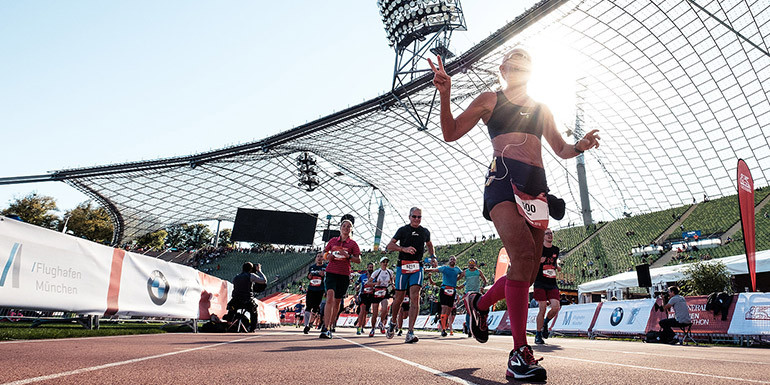
Munich was my third marathon, the other two being the Cape Cod Marathon in Falmouth, Massachusetts, and the Little Apple Marathon in Manhattan, Kansas. Needless to say, the stage was much bigger last weekend. The Munich Marathon begins and ends in the center of the Olympic Stadium. As I started the race and sprinted out of the stadium where Frank Shorter won the 1972 Olympic Marathon and sparked the first wave of American distance runners – a wave my grandfather (2:25:30) was a part of – I felt a surge of adrenaline and, over the first few miles, my pace dropped well below the intended 7:45/mile.

My initial plan had been to run the first ten miles at 7:45, the next ten at 7:40, and then drop down to 7:30-7:35 for the last 10k. Instead, I allowed the hype of the race and the emotions of the city and its heritage to overcome me and, for the first ten miles, I averaged a 7:10 mile. Over the rest of the race, I slowly dropped the pace until the last few miles I averaged 9:30/mile. My average pace ended up being 8:03; about twenty-five seconds slower than planned.

I ran the 2021 Munich Marathon in the Atreyu Running Company’s carbon-plated racing shoe: The Artist. I had previously logged about twenty miles in the shoes, just breaking them in, so I knew they were relatively fast. It was clear that the team at Atreyu Running put time and effort into The Artist; the shoe performed well, but there were two things specifically I noticed about the shoe. First, my right shoe seemed like it was slipping a bit around mile 8 as if the laces had loosened after I started running. Second, while throughout the first half of the marathon I felt as if I was gliding, during the latter half of the race my feet felt like they were being slapped with meat grinders. While this could partially be a product of low mileage during the train-up (I only averaged 30-35 miles per week) I suspect The Artist is more of a half-marathon shoe. That is, at least, how I intend to treat it moving forward and plan to race my next marathon in something like Adidas’s Adizero Adios Pro or Saucony’s Endorphin Pro.

Speaking of mileage, I absolutely maintained a low volume throughout my training cycle. Conventional wisdom states that you should hit around 40-50 miles per week when training for a marathon. While I maintained a consistent mileage for most of my buildup, it ended up only being about 30-35 weekly miles for the two months leading up to the race. I was able to max out my long run at 19 miles, but all-in-all I didn’t have enough mileage throughout the week. Moving forward, improving my weekly mileage should help in the later miles of the race.

During my 2020 buildup, I had about the same weekly mileage, but I was also lifting regularly throughout the training cycle. I squatted and deadlifted, in addition to other accessory lifts, twice a week, which greatly benefitted my ability to grind out the last six-eight miles of the Little Apple Marathon. I’ve written about the benefits of strength training for runners before but suffice it to say I failed to follow my own advice training for the 2021 Munich Marathon. I simply did not have the time or energy to get in the gym as much this year, and it showed in the last 10K.

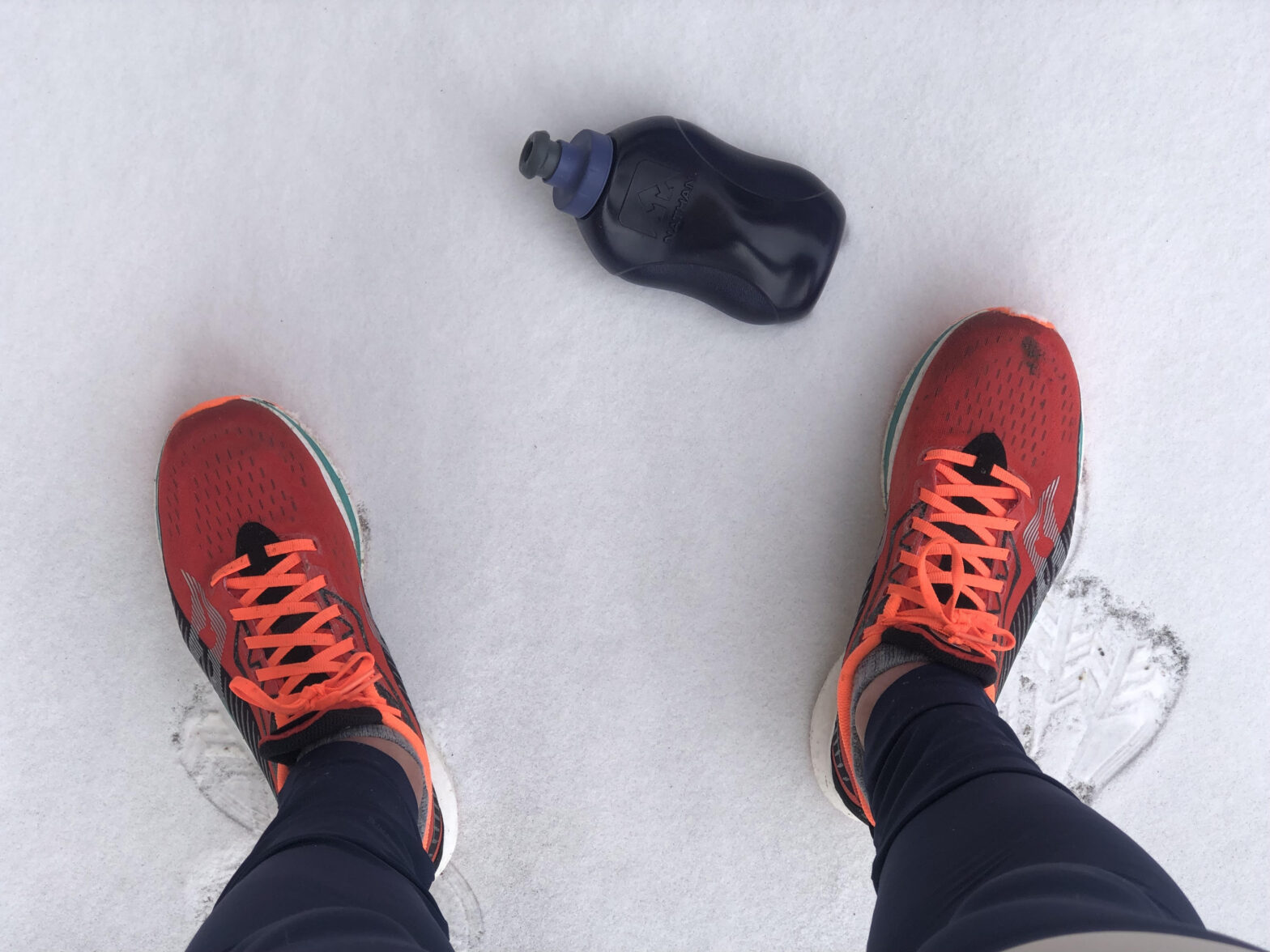
Another major change I made was the decision not to carry a water bottle with me. This was clearly a mistake. I had forgotten what a mess water stations can be, not to mention how difficult it is to drink out of a cup while running without getting 80% of the water on your face, shirt, and up your nose. It’s not that much more difficult to just run with a bottle either in your hand or on an athletic belt. In the past, I’ve used Nathan’s Trailmix Plus hydration belt, but any bottle you feel comfortable carrying for most of the race will work. Eventually, I stopped trying to get water from the water stations and I probably was underhydrated most of the race. I won’t make that mistake again, and neither should you!

Overall, the 2021 Munich Marathon wasn’t a bad race. It was orchestrated well, the team took great care to ensure the runners were taken care of, the course clearly marked, and common-sense Covid-19 precautions enforced. I made quite a few blunders – some of them rookie mistakes – but at the end of the day I learned a great deal from them and I have quite a few more marathons left in me to improve. I still dropped seven minutes and a PR is a PR, no matter how ugly. The race left me beat down and exhausted, but craving more and I can’t wait to run my next 26.2.

If you liked this article, check out: What the 2021 Olympic Marathon says (and doesn’t say) about the Future of American Marathoners

What the 2021 Olympic Marathon says (and doesn’t say) about the Future of American Marathoners

The American field for the 2021 Olympic Marathon was tenuous from the start. The original trials were held in February 2020 before Covid-19 forced the postponement of the Tokyo Games. Once it was clear that the Olympics would not be held in 2020, many advocated for a 2021 redo of the marathon trials. The argument was that an extra year to train – or degrade – would affect who the United States should send in 2021. Ultimately, USATF decided not to conduct another trial for the marathon, but many still asserted that there were athletes ready to fight for a spot on the Olympic team. This point was further made when The Marathon Project was held in December 2020; seven men ran sub-2:10 and six women ran faster than the top finisher in the trials.

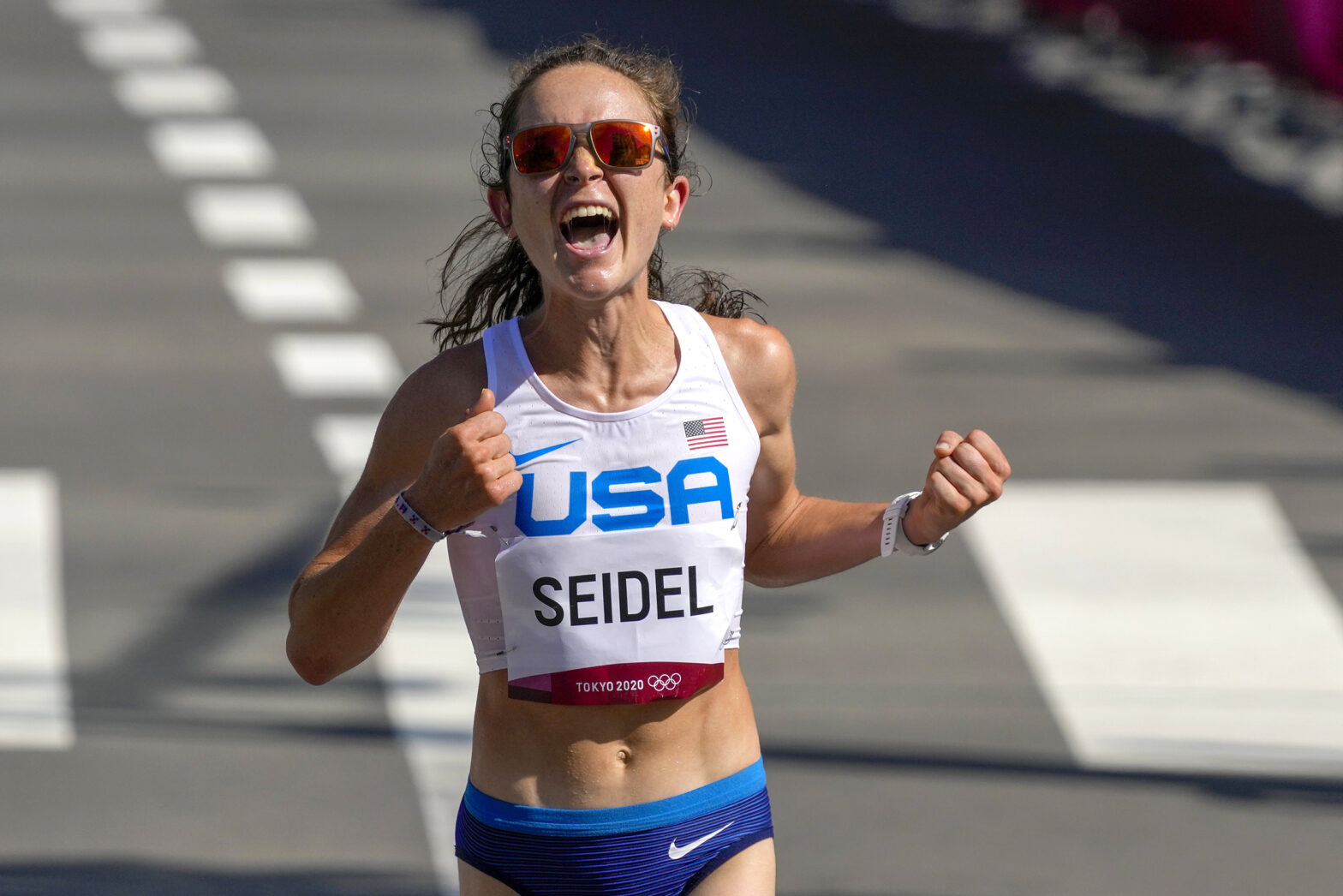
In Tokyo, critics were proved right both in the respect that the extra year benefited some of the athletes at the games and that it was the detriment of others. For Molly Seidel, the extra time to prepare led to a strong bronze medal finish. Most significantly, perhaps, was that she only finished ten seconds behind Brigid Kosgei and twenty-six seconds behind Peres Jepchirchir. The race was only decided in the last quarter mile. Sally Kipyego finished seventeenth, while Aliphine Tuliamuk dropped out of the race at 20 km. In the men’s field, unfortunately, Americans Galen Rupp, Jacob Riley, and Abdi Abdirahman failed to impress. Rupp – who won the bronze medal in 2016 – finished 8th, while Riley and Abdirahman finished 29th and 41st respectively.

Of course, there are many circumstantial factors that played into this, the foremost being the heat and humidity in Tokyo in early August. It was clear even before the race started that there would be no world records in those conditions, but – excluding Molly Seidel – the American performance was not as expected, especially given the number of rising stars in the Marathon distance.

So, can we really make predictions or judgments about the state of American marathoners based on the Tokyo Olympics? It would be unwise to do so. It is important to remember that many of the nation’s top athletes did not race at the Olympics – especially in the women’s field. Des Linden, Molly Huddle, and Sara Hall were all notably absent. This leaves all eyes on two upcoming races, the Boston Marathon on October 11th and the New York City Marathon on November 7th.

The 2021 Boston Marathon will not be fuel for world records – the terrain doesn’t lend itself to speed – but rather a battleground for those daring to challenge the course. Des Linden, 2018 champion, 50K World Record Holder, and Boston Marathon regular, and Molly Huddle will be representing the American field. They will be competing against multiple sub-2:20 marathoners to include Yebrgual Melese, Mare Dibaba, and Edna Kiplagat. Linden will be looking to claim another victory on a familiar course, while Huddle will be looking for redemption after dropping out at the trials in 2020. In the men’s field, Abdi Abdirahman leads a strong group of sub-2:10 Americans, which includes Scott Fauble, Colin Bennie, and Scott Smith – the latter three being top performers at the 2020 Marathon Project.

Even more exciting to watch will be the 2021 New York City Marathon. While the elite men’s field has not been officially announced, we know that Jared Ward and Noah Droddy will both be competing. Additionally, Ben True (2018 NYC Half Marathon champion) will be making his marathon debut. They will be competing against Shura Kitata, Abdi Nageeye, and Kenenisa Bekele, which, if they can stick with them, should drive the Americans to even faster times. The women’s event is the deepest American lineup in a long time. Des Linden, Molly Seidel, Sally Kipyego, Aliphine Tuliamuk, and Emily Sisson will all be competing for the top spot. They will also be racing Brigid Kosgei and Peres Jepchirchir, setting up an Olympic rematch and a stage for the Americans to potentially demonstrate their speed.

Ultimately, while the Olympic Marathon was not the proving grounds that it could have been for American athletes, the future remains bright. Both the 2021 Boston and New York City Marathons are primed to become stages for Americans to step into the spotlight – and much of the nation’s talent has not yet truly come into its own. While we may not see an American Eliud Kipchoge in the near future, American runners are on the cusp of dominance in the marathon.

If you liked this, check out: What happens when the NFL meets Track and Field?

The Barefoot Beach Run

One of the most iconic things about summer running is the barefoot beach run. There’s something about the sun and the water that makes a runner want to kick off their Cliftons and dig their toes into the sand with every stride. While barefoot running deserves its own, separate blog post (or several), with summer creeping around the corner and many people planning beach trips it seems the perfect time to talk about running at the beach.

I had seen many people running barefoot on the beach during past vacations. Last year, incidentally while I was reading Born to Run for the first time, I decided it was time to give it a try. I was at the very beginning of my training cycle for the Little Apple Marathon and had already established a strong cardiovascular base. I had also nailed down my running mechanics going into the training. Observing others doing the same thing, I decided my best course of action would be to run close to the ocean, treading on the soft, damp sand. After a mile I was hooked.

There are, however, a few things I wish I had known before starting my own barefoot beach run. It’s important that you start short and slow. I was averaging 20-25 miles per week on the roads, easily hitting 4-6 miles a day. But it’s a different beast when you aren’t wearing shoes. My first run was about a mile and a half, just to feel it out. The next day I went for a four-mile out-and-back after the success of my first run. While I was fine on the first two miles, after I turned around the sand began biting into the soles of my feet. The damp sand that had been my cushion began to cut between my toes and every stride became an effort to keep my feet from chafing.

Beach runs offer unique physical and mental benefits, but high mileage runners should not expect to reproduce the same distances on the sand that they do on the road. The average beach trip is about five days, which is not enough time to build up the calluses on your feet required for longer runs. For those trying to maintain a more intense training regimen one solution is to split your workouts between road and sand. For example, run 3-5 miles in the morning on the roads and then 1-2 miles in the evening on the beach. The beach also provides an excellent opportunity for cross-training. The ocean is an excellent place to swim for 20-30 minutes before going on a 1-2 mile beach run. Just be sure to follow all posted safety warnings and guidance from lifeguards.

One argument for running barefoot is based on humans’ anatomical design and the fact that the Achilles tendon is built perfectly for the mid-foot strike promoted when running barefoot. But proponents of barefoot running sometimes forget to mention that while we may be designed to run this way, we’ve grown up essentially wearing a cast on our feet for most of our lives. In the same way that your arm or leg is weak when taken out of a cast after weeks or months of recovery, your feet aren’t ready to run miles and miles without shoes right away. As I mentioned before, this topic deserves its own blog post, but it will suffice to say it’s important to understand that, even if you assume we are designed to run barefoot, our feet need time to rebuild strength before we can start to think about removing shoes from the equation completely.

That said, there are still benefits to running barefoot on the beach, even if you only have a few days. Running short distances barefoot can help strengthen underdeveloped muscles in your feet. It’s also an incredibly low-impact event compared to running on pavement. Running is known to be tough on your bones and joints so getting even a quarter of your weekly mileage in on sand will help you recover from your more intense workouts.

While the impact is lower, the effort is often higher with beach running. Because the sand is soft, the energy return is lower on each stride. The same distance covered or time spent running on sand is about 1.6 times harder than running on pavement. The softer sand, higher up the beach, offers even more of a challenge – and more of a hazard for the barefoot runner.

If you take it in moderation, the barefoot beach run can be an enjoyable, refreshing change of pace from your standard workouts. Be mindful, though, that while sand is softer and can provide a great recovery for your skeletal system, it is also less stable than pavement and can easily lead to a sprained ankle. Watch your step and try to avoid any areas that consist of less than sure footing. The most injuries occur when athletes scale up their mileage too quickly and trying to replicate their regular training schedule on the beach. 

As Covid-19 restrictions are lifting around the United States and summer is approaching, the beach offers a chance to both relax and integrate different ways of working out into your training. If you live in an area close to the coast, it might be beneficial to incorporate a beach run once a week into your schedule. If you’re traveling to the beach for a vacation don’t try to replace your regular miles with barefoot beach miles, but rather incorporate them into your plan for the week as a recovery or as a shorter workout. Finally, don’t forget to enjoy yourself. While it’s important to get a good workout in, the best thing about the beach is that it provides an opportunity to relax, reflect, and recover from the hustle and bustle of day-to-day life.

What are your thoughts on the barefoot beach run? Is it something you incorporate religiously into your beach trips or a practice you vehemently avoid? Leave a comment to let us know your tips for maximizing training at the beach!

If you liked this article, check out: Why I Lift Weights as a Runner.

Ode on the Fartlek

There are few greater joys than running fast and free. At its core, running is about building and expressing speed. One of the ways we choose to express this hard-earned speed is through racing. We track distances and log times in a coordinated effort to document speed. We post about fast times on Strava and, sometimes, on Instagram and Facebook. We caption our slow days with names like “great recovery run” and “kept it under 140 bpm” so everyone knows we were intentionally not running fast. At the end of the year we share our packaged, consolidated data, including total miles run, average paces, and improvement from January to December.

Also, this technically is not an ode. I feel obligated to mention that. My apologies to anyone who feels misled by the title, but if you’re interested in running poetry we can make that happen.

A data-driven training plan is an excellent tool, one I lean on pretty heavily myself. But there’s something to be said for expressing speed without the constraints of a proscribed workout, a pace-plan that’s been on the calendar for weeks. Running, in its true form, is about freedom.

Fartlek, in the Swedish, means “speed play.” A fartlek is a type of workout in which the runner, literally, plays with speed. Feel like running fast? Run fast for a few minutes. Want to switch to threshold pace? Bounce between 5k and marathon pace? Go ahead. There is no proscribed intensity, just run as fast as you want for as long as you want and drop the pace when you need to.

There is something incredibly gratifying about stepping out of the regular training pattern and just running how you want to, when you want to. This is, after all, how we all learned to run. As kids, we first learned to walk and, after mastering that skill, began exploring how fast our feet could take us. Running around a playground, down a dirt road, or through an open field is an expression of speed fueled by curiosity and a lack of concern for limitations. Our inner child isn’t concerned with numbers.

It’s this childlike discovery and ecstasy that I feel when I let the pace go and just run. It’s not something that needs to happen on a weekly basis, but can be interspersed every few weeks. I find it important not to schedule a fartlek, but to just let it happen. Some days I just need to run without constraints. I try to run fartleks on speed days because, after all, they are a speed workout. But putting a label on it, only fitting it in if it makes sense, defeats the purpose of doing it.

The freedom that comes with running without a watch, or without a proscribed pace, is crucial to maintaining a healthy state of mind for a runner. Too often on social media, in podcasts, or in conversations with other athletes I see people getting caught up in the numbers, allowing their identity to become intertwined with how fast they run, whether they hit their weekly mileage, or how many sprints they do on speed days. While our sport is about doing all you can do get faster, it can’t come at the price of your mental health.

May is Mental Health Awareness Month in the United States and I’ve been debating for several weeks how best to approach the topic. While we are certainly getting better as a society, mental illness is still a relatively taboo subject and that needs to change. I’ve never struggled seriously with mental health, but I have friends and family who actively battle it. I’ve had a friend commit suicide. I’ve known others who came close. I bring this up to reiterate that mental illness is a real struggle that many around us deal with. And often we don’t even realize it.

While the physical act of running provides solace to so many people, the sport offers another form of medicine in other runners. It’s been shown time and time again that the most important thing in helping someone struggling with mental health is for someone to reach out to them. While the running community is far from perfect, it offers an opportunity to help those around us with just a few words. Take the time to ask the people around you how they are doing and, more importantly, listen. In many cases, the thing that stopped someone from doing something irreversible was a friend asking “how are you?”

I’m not a psychologist and I am certainly not a subject-matter expert. But I do know that freeing yourself from the constraints of pace and time can help increase your peace of mind, if only fractionally. Fartleks offer the opportunity to take a step away from your regular routine and ease the regular stressors in your life. But beyond running, if you’re struggling please reach out to those around you. If you aren’t battling mental illness yourself, check up on the people you run with and be cognizant that they may be working through something you aren’t aware of. They might just need someone to talk to.

At the end of the day, mental health is a serious issue that affects many more people than we have statistics for. If you are struggling, reach out to someone around you. There are also more resources that are available. In the United States you can dial 911 and ask for the mental health hotline. Most churches and religious centers are open for those who need to talk. If those options fail or are not available, you can visit the National Alliance on Mental Health website.

There are many ways you can help raise awareness for mental health in your own community, but for runners one option is to organize a Blue Jean Mile. In 2019, Johnny Gregorek broke the world record for one mile in blue jeans in an effort to bring more attention to those struggling with mental illnesses. While you might not be able to break the world record, running a mile in blue jeans is a small representation of the pain and discomfort that comes with mental illnesses. It is also a great way to talk to people about mental health when you get questions about why you aren’t wearing regular running gear. You don’t, however, have to organize an event or run an online campaign to help those struggling right now. The battle against mental illness begins with three words: How are you?