
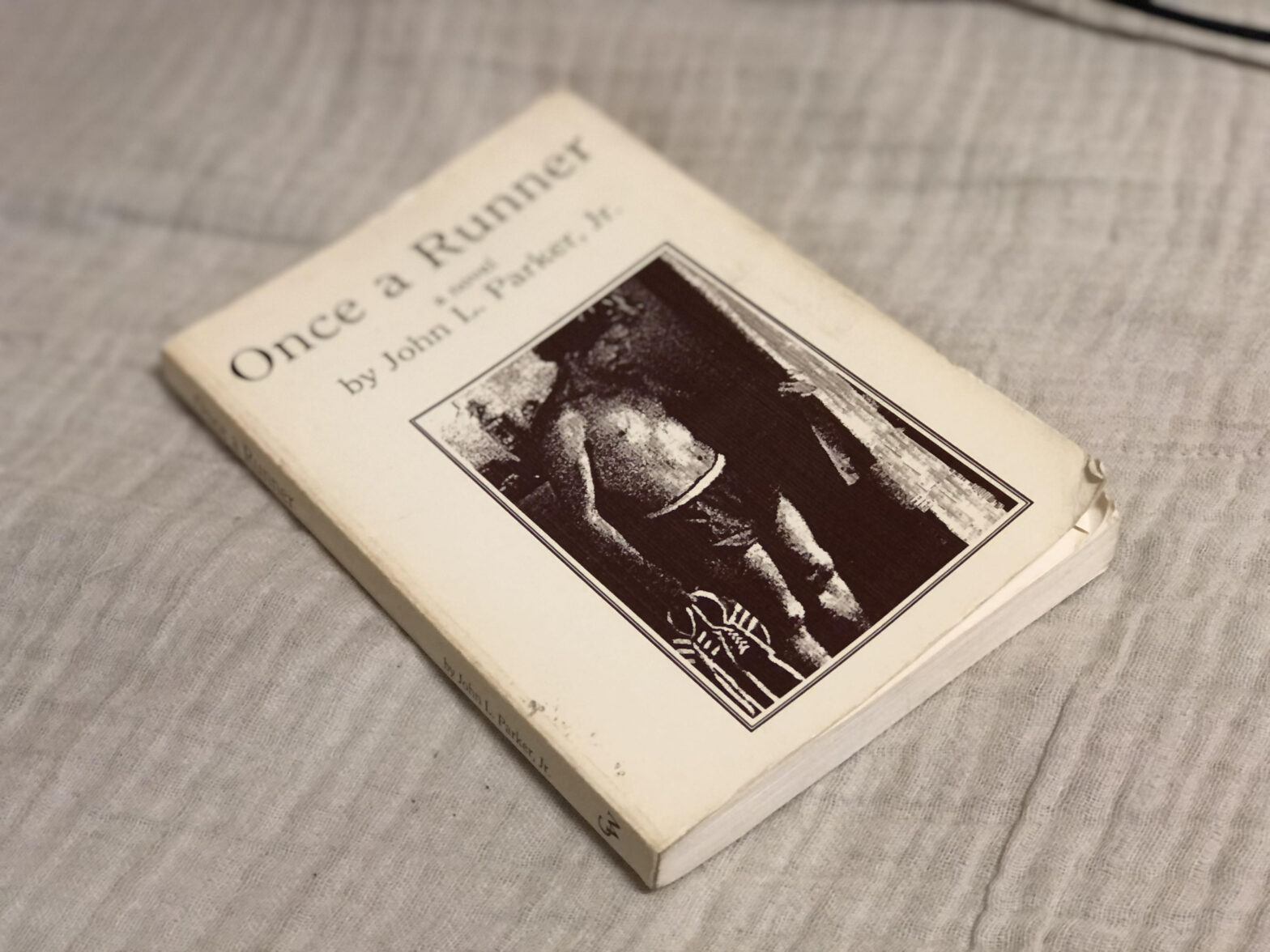
How do you review a book that so many have read and loved, that’s been dissected and written about for years? I’ve read Once a Runner twice now and gone back and forth on the best approach to take addressing it on the blog. It’s something I want to talk about, but without just repeating the same praises so many others have heaped upon John L. Parker Jr. It’s a damn good book and every runner should read it. It’s the best running fiction to ever grace the bookshelves of aspiring track athletes and collegiate cross country teams. It’s a cult classic, the kind of novel that gets lost in translation; Once a Runner is a book you can’t understand if you’ve never felt the euphoric feeling of flying across the pavement, the trail, or the track, understanding that you’re pushing as hard as you can go but still have miles left in the tank. You might, in fact, be offended by its brusque, dismissive arrogance. But you’ll still love the book.
With that out of the way, if you want to read a classic review of Once a Runner check out Marc Tracy’s commentary on the best novel ever about distance running or Patrick Gibson’s follow-up review in Citius Magazine. If you want to hear all about the book’s shortcomings, a warning to the uninitiated, read Caela Fenton’s takedown in Canadian Running Magazine. But, if you want to know why Once a Runner has been devoured by generations of runners and will always be a powerfully flawed, masterful ode to our sport, read on.
Once a Runner speaks to the hypothetical realization of peak running. Quenton Cassidy, the book’s protagonist, doesn’t represent what every runner should be, but rather what every runner could be. Parker’s novel is littered with countless pieces of wisdom and memorizable phrases such as “a runner was not made by winning a morning workout” that stick with the reader long after they finish the book. He writes about the altar of Consistency, upon which the runner sacrifices daily to improve. Regardless of their level, every athlete who reads this passage can relate; every reader understands the significance of a missed workout or mileage that was never completed.
John L. Parker Jr. didn’t write Once a Runner for everybody, he wrote it for runners. One of the most significant themes that pervade the book is the Trial of Miles; Miles of Trials. This is, perhaps, the most important thing for a runner to understand; something Bruce Denton, Quenton Cassidy’s mentor and friend, imparted to him early on and something he and his partner in crime, Jerry Mizner, try to instill in their younger teammates – those who haven’t quite grasped the commitment and consistency required to become a runner. While most people who read Once a Runner will never run a four-minute mile, or dial in multiple hundred-mile weeks, the Trial of Miles is something every runner understands. You can only get so far on natural talent and grit. Our sport is relentless and unforgiving in its refusal to yield improvements to those who hesitate when it’s raining outside, or the humidity is too high. A runner only improves by running, not by not-running. Parker knows this and, more importantly, he knows that every runner knows this – whether they embrace it or not.
One of the most significant events, albeit only addressed in a few paragraphs, is Jerry Mizner’s ailment that takes him out of the running game for a few months. Sooner or later, almost inevitably, runners will experience injury. Every runner knows it, and smart runners know how to identify the onsets and how to back off for a few days or weeks in order to prevent being sidelined even longer, but the truth of injury is there and Mizner’s unfortunate downfall is a brief, but important, glimpse of realism in a book about the hyperreality of peak-performance running. Jon Waldron has written a bit more extensively about the Mize’s quick exit from Once a Runner, but suffice it to say that this snapshot is more important to being a runner than its proportion to the rest of the book.
Parker writes with emotion, but it’s not just because he’s a great writer – which he is – it’s because he knows the subject material better than anyone. Parker was once a runner as well. He broke eight distance running records at the University of Florida, including a 4:05.2 mile and a 2:33 marathon. He was the national champion in the steeplechase and the second-place finisher in the three-mile his senior year and trained and competed with Jack Bachelor and Frank Shorter (of Olympic renown). This is why Once a Runner feels, more than anything, authentic. Parker isn’t just writing about an experience some have had, he’s writing about an experience he’s had. He writes passionately about running because he is passionate about running. He has lived the Trials of Miles; Miles of Trials and sacrificed at the altar of Consistency. He’s kept a diligently annotated training calendar and felt the unforgiving blankness of a missed workout. If Parker wasn’t once a runner, he wouldn’t have been able to write a book that has impacted millions of cross country and track athletes across multiple generations. But he knows better than most what it means to be a runner and, because of this, Once a Runner feels genuine. Readers know intuitively that this isn’t a novel created by a writer, but rather a beautifully documented account of our sport written by a writer who was created by running.
The thing is that while most readers will never run a 4:05.02 mile in their lives, all runners know the grind, the Trials, and the consistency it takes to improve. In one of the most climactic chapters of the book, Bruce Denton has Cassidy run twenty 440s, three times over. That’s 60x400m for you math people. After the workout, he collapses into bed and sleeps for eighteen hours. The point isn’t that you have to run an absurd number of quarters to become a runner; instead, it’s a hyperbolic illustration of the fact that you have to push yourself beyond your perceived limits. Parker knows firsthand that the biggest barrier to success is the person staring back at you in the mirror. The only thing keeping you from being great is your reluctance to turn the doorknob and get out onto the pavement. And this is the true strength of Once a Runner. Practically nobody who reads the novel will ever know what it’s like to run 60x400m, but every runner can know what it’s like to push themselves past their previously understood limits and to achieve success beyond what they once thought possible.
Once a Runner tells its readers that they can be more than they ever believed they could be. The whole book is about Quenton Cassidy’s pursuit of a four-minute mile. He gets closer and closer to his goal; he actually achieves it first in a time trial – a fitting bit of irony since every runner knows time trial miles don’t count. At the end of the book, in his last collegiate attempt to break four minutes, Quenton Cassidy runs a 3:52.5. After an entire season of chasing fractions of a second to break 4:00.0, he beats it by nearly eight. The message in the climax of the book is clear: you can achieve well beyond what you thought possible if you’re willing to work for it.
Every page of Once a Runner is a delight to read and, for the runner, inspiration in every paragraph. While I can’t recommend this book as a couch-to-5k read (Check out Born to Run if you are in that population), it truly is an imperfect masterpiece and one that should be on every runner’s bookshelves. If you haven’t yet read the story of Quenton Cassidy and Bruce Denton, I highly suggest this as your next fiction read. It’s available on Amazon, Thriftbooks, and Audible; while I don’t personally listen to books on my runs, if you’re a big audiobook person I can’t imagine a better book for your next long run.
Once a Runner Rating: 9.1/10
If you liked this article, check out: Consistency in Running: Accountability Matters!