
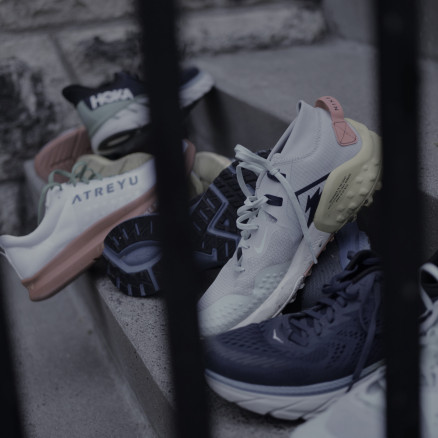
You’ve probably heard it before if you’ve been reading the blog for a while, but most runners have more than one pair of shoes. In fact, building your running shoe rotation is one of the most important elements of higher-level running. There are a few reasons for this, but mostly it comes down to the simple fact that different shoes are manufactured for different purposes. Perhaps the most drastic example of this is that you would never wear a spiked track shoe on a trail run and, similarly, you wouldn’t wear a trail shoe on the track.
Of course, this creates both confusion and controversy. Not all runners can afford multiple pairs of shoes and not everyone necessarily subscribes to the idea that you should change out your shoes. But, most importantly, many new runners don’t know how to build a sustainable shoe rotation because they don’t understand how to use different types of running shoes in training. Additionally, the market is saturated to the point that it can be incredibly difficult to distinguish between types of shoes without some sort of help.
There are more ways to structure your shoe rotation than there are iterations of the Nike Pegasus, but there are a few basics to consider when building out your own selection of shoes. The idea is to use the right shoe for the workout, but to do so you must first understand how shoe companies break down the different styles of running shoe.
The Everyday Trainer
This shoe is the most common among runners. The everyday trainer is designed to be a versatile, “do-everything” shoe that you can use regardless of the weather, terrain, or workout. These are low-specialization shoes that will work with minimal thought. You can throw a pair of these in your suitcase and still be equipped to execute every workout on the schedule without sacrificing much in the way of performance.
The everyday trainer can be further broken down into lightweight, regular, and max-cushioned trainers. This is because some runners prefer a more padded approach, generally, and other runners want a slimmed down experience. I personally keep both a lightweight and regular trainer in my rotation, which I swap depending on how my knees are feeling. Everyday trainers are great for “garbage miles” and runs that don’t necessarily have a specific purpose. I usually run in some sort of daily trainer in between my speed workouts and my long run days.
Regular Daily Trainers: Brooks Ghost, Saucony Ride, HOKA ONE ONE Clifton
Lightweight Trainers: Brooks Launch, Saucony Kinvara, HOKA ONE ONE Rincon
Max-cushioned Trainers: Brooks Glycerin, Saucony Triumph, HOKA ONE ONE Bondi
The Performance Trainer
The performance trainer is a shoe designed to strike a balance between race-level performance and training-level durability. These shoes can take more miles than a racing flat, but offer a more tailored experience than the daily trainer. They are lighter and usually offer a bit more traction. Performance trainers are great for tempo days, threshold workouts, speed days, and of course your long runs. While you can certainly progress and see improvements doing these workouts in a daily trainer, wearing a performance trainer is more efficient.
Performance Trainers: Brooks Hyperion Tempo, Saucony Endorphin Speed, Nike Pegasus Turbo
The Racing Flat
Finally, it’s time to race! Racing flats are the ultimate evolution of running shoe. They are lighter and more optimized than any other shoe and usually come with a similarly appropriate price tag. Recently, companies have begun using a carbon plate to enhance performance and running economy. Owning a racing flat is not necessary, but highly recommended for optimal race outcome because, as I mentioned just now, they are created specifically to be the most optimized piece of equipment you’ll own as a runner. Unfortunately, this also means most racing flats have a limited mileage ceiling (often around 100 miles). If you aren’t a serious runner, the benefits of a racing flat aren’t likely to be that high, but they will certainly make you feel faster and that is half the battle. If you are getting more serious about running I would recommend trying a cheaper racing flat without the carbon plate before dropping $200 on the Nike Alphaflys (assuming you can find a pair) and trialing those in a race.
Racing Flats: Saucony Type A9, Altra Vanish-R
Carbon-Plated Racing Flats: Nike Alphafly, HOKA ONE ONE Carbon X, Saucony Endorphin Pro, Brooks Hyperion Elite
The Trail Shoe
Whether you are a trail runner or not, everyone should have a trail shoe in their rotation. Trail shoes are built specifically for, well, trails, and while it’s true you could break out your daily trainers, trail shoes offer a variety of protective features your Clifton 7’s don’t have. Trail shoes come with lugs which prevent slippage and offer more efficient transfer of power. Most models also have a rock plate, which keeps sharp debris from puncturing your shoe. If you run trails at least once a week, it would be advantageous from both a safety and training perspective to look into buying a pair of trail shoes to employ on those runs.
Trail Shoes: Saucony Switchback, HOKA ONE ONE Speedgoat, Brooks Cascadia, Nike Wildhorse
At the end of the day, you only need one pair of shoes to run. Two pairs and you can alternate runs, allowing your shoes to rest between efforts and prolonging their life. But if you want to take your running to the next level it helps to have the right shoe for the right workout. If you have some extra change, start looking at building out your shoe rotation. If the piggy bank is a little skinnier than you’d like, check out my article from last week on how to save money on running shoes!
While there are, of course, even more specific categories of running footwear (toe shoes anyone?), these are the four most basic types you should consider when thinking about buying new shoes. What shoes do you include in your rotation? Do you have a favorite go-to trainer? Leave a comment below to let us know your thoughts!
If you liked this article, check out: How to Never Pay Full Price for Running Shoes Again.
One thought on “Building Your Running Shoe Rotation”
Comments are closed.