
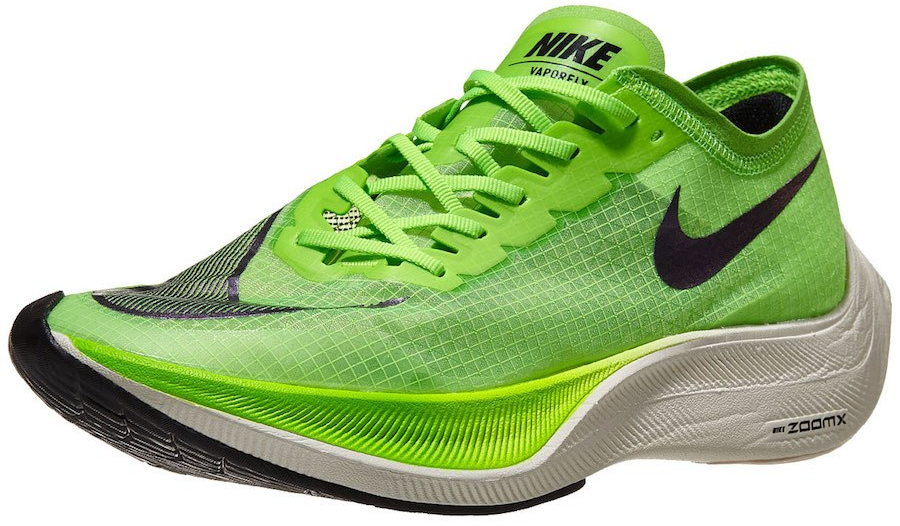
You’ve probably seen them, or at least heard about them. The Nike Vaporfly Next%. The Brooks Hyperion. The Hoka One One Carbon X. These carbon-plated running shoes are the fastest on the market and, for the last two years, have been worn by every record breaker in nearly every distance.
In 2019 Eliud Kipchoge became the first person to run a marathon in under two hours. He was wearing the Vaporfly Next%. Just a few months ago, Jim Walmsley broke the 100k American record. He was wearing the Carbon X 2.
The common thread among these record-breaking shoes is the carbon plate which runs through the sole of the shoe. In theory, the plate helps improve running economy (measured by the amount of oxygen your body can deliver to your muscles at a specific velocity), making runners’ strides and form more efficient. Nike’s Next% line advertises a 4% increase in output capacity. Other companies are not so specific, but still market their carbon-plated shoes as helping runners improve their speed.
While there have been skeptics of this approach, extensive testing and racing in the shoes have helped prove their efficacy. The idea behind the carbon plate is that it increases responsiveness in the foot strike, propelling the body forward so that you can go further in each stride with the same amount of force. But the net gain remains marginal. The 4% return is not an exact figure and, furthermore, faces problems in scaling. For example, someone who runs a ten-minute mile is not necessarily going to shave thirty seconds off simply by wearing a pair of these carbon-plated shoes. They might, however, improve their stride and, over time, decrease their mile time because of improved technique.
The benefits of carbon-plated running shoes are reaped mostly by the elite runners: those who stand the most to gain by a few seconds taken off a 10K, or a minute taken off a marathon. But of course, that hasn’t stopped everyone else from buying a pair of these shoes to try for themselves. When Nike released their Alphafly Next% model (the follow-up to the Vaporfly) they sold out online in just a matter of minutes.
The market is becoming increasingly saturated with carbon-plated shoes and it is likely that – if they haven’t already – they will become the standard for every race, from the marathon to the local 5K. Saucony has seen widespread success with their Endorphin line, which offers a carbon-plated racer as well as more affordable, slower, options. Sketchers has released its GOrun Speed Elite carbon-plated racer. Even the Atreyu Running Company has come out with its own budget option in The Artist.
The unfortunate thing about carbon-plated shoes, however, is the price. I cannot, in good conscience, recommend the average runner to sell their couch and purchase running shoes that average over $200 a pair. It can be easy to forget that elite runners often wear shoes provided to them by their sponsor. Eliud Kipchoge and Jim Walmsley are sponsored by Nike and Hoka One One respectively, which is why they always wear the latest models of shoes from those companies.
Mileage on these shoes is also a problem if you don’t have a good method to manage it. Carbon-plated shoes, built for high performance and speeds, have a lower lifespan than other types of shoes – around 100-150 miles. It’s possible that a consumer might go buy a pair of Vaporflys because of the hype, use them for every run, and ultimately wear them down without getting their proper use out of them.
In my opinion, the best use for carbon-plated shoes – if you choose to invest in a pair – is for racing and speedwork. Maybe do a little bit of tempo work so you can feel race-pace in your race shoes. This should last you about 1-2 training cycles, depending on the distance of the race. Run 50-75 miles in them during your train-up and then put the last 25 miles into them on race day.
Carbon-plated running shoes are cool and I can’t wait for them to become the industry standard as the market saturates and the price-point becomes more reasonable. Until carbon-plated shoes become more widely available at lower prices, we aren’t likely to see them at our local 5K and are probably best served by trusting the shoes we’ve been training in. Unfortunately, that doesn’t stop me from wanting a pair of the latest and greatest for myself!
Have you used carbon-plated shoes in training or racing? What was your experience? Was it worth investing in a new pair of shoes and would you recommend it to others?
If you liked this article, check out: How to Never Pay Full-Price for Running Shoes Again.