
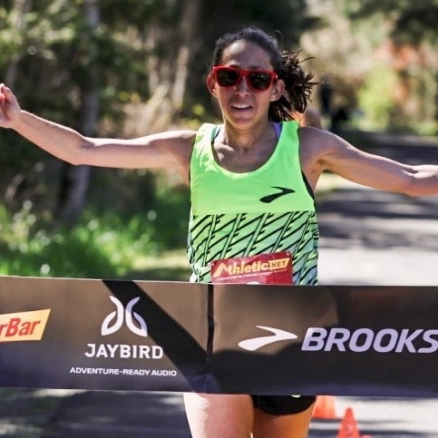
In a moment last week unlike any other in this new age of running, we experienced something truly awe-inspiring and inherently motivating. We already knew Desiree Linden was a beast. For the uninitiated, Linden’s resume includes two stints representing the United States at the Olympics (2012 and 2016). In 2018 she became the first American woman to win the Boston Marathon in 33 years. Last February, she came 11 seconds away from making her third straight Olympic team in a field of runners saturated with talent, both new and old.
In the wake of the Olympic trials – and 2020 in general – Des Linden set her sights on a longer distance: the 50k. A few months ago she announced she would be racing the distance and attempting to break the standing world record of 3:07:20. On April 13th, 2021 she not only destroyed the previous record but became the first woman to run a sub-3 hour 50k with a time of 2:59:54.
The 50k is the shortest distance officially considered an ultramarathon. Technically, anything beyond the official marathon distance of 26.2 miles would be an ultramarathon, but it is generally accepted that 50k – or 31.1 miles – is the baseline. It was previously the case that the marathon was this somewhat unattainable distance that people considered a bucket-list event. While it is true that the marathon remains an impressive feat, the popularity of the distance has increased to the point that it is no longer out of reach for most people. Over 500,000 people run marathons every year in the United States. At this point, the likelihood of you knowing someone who has run 26.2 miles is higher than ever. Of course, if you have a lot of runner friends this likelihood goes up exponentially.
Born to Run author Christopher McDougal astutely observed that when times get tough people turn to running. Over the course of modern American history there have been three waves in which participation in running increased: during the Great Depression, the Vietnam War era, and directly after the 9/11 terrorist attacks. It stands to both reason and observation that the Covid-19 pandemic has had a similar effect on people.
In fact, the drought of races in 2020 created a necessity for people to come up with their own ways to compete. We saw runners across the country smashing Fastest Known Times (FKTs), people completed entire marathons in laps around their house, and many athletes joined Des Linden in running Destober – running the number of miles every day that corresponds to the calendar date for the month of October.
When asked to comment on her upcoming 50k race, Des replied that the road 50k is the new marathon – and there is a lot of evidence to support this. In terms of popularity, the marathon is becoming more and more commonplace. As I mentioned earlier, the distance is losing its allure as an unobtainable feat of human accomplishment. There appears to be a sweet spot where a race is completed infrequently enough to maintain its mystique, but not so frequently that it fades from the spotlight. For example, the 100 mile footrace is incredibly grueling but completed by so few people that not many non-runners are even aware of it. The 50k, on the other hand, is slowly starting to creep from an obscure ultra event into the mainstream.
Times are getting faster as well. Part of the reason why ultras are in a different category is because they are simply too long to maintain a reasonably fast pace throughout. But Des ran her 50k at a 5:47 pace, just seconds slower than her marathon PR and knocking a full seven minutes off the standing world record. She proved several points last Tuesday. First, she demonstrated that a woman could crush the 3 hour barrier. More importantly, perhaps, she showed that you can run 31.1 miles at a pace similar to marathon pace, meaning that her aerobic threshold and cardiovascular capacity could last longer than is generally understood. The 50k can be a fast race too.
Linden is changing the game for American distance runners and for the ultra world as a whole. She, among others, has inspired others to run longer and farther than they thought possible. She showed that longer distances can be fast too. And she set a new bar for American runners.
While Americans have not been dominant in the marathon for decades (though that is a discussion for another day), the 50k provides an opportunity for Americans to excel. Top female, American marathoners often put up personal bests between 2:19 and 2:21 and oftentimes they skew towards the slower end of this spectrum. While this is insanely impressive, in the age of carbon-plated shoes and highly dialed in training marathons are often won in the 2:17-2:18 range. And American men are not off the hook either. While there were seven men at The Marathon Project in December who ran in the 2:09 range (and one 2:08), marathons are won in the 2:02-2:05 range.
I think elite marathoners like Sara Hall and Noah Droddy are on the right track and a lot of the progress in the last two years is certainly due to the rising popularity of the distance. American marathoning will be great again. But in the meantime, some of these elite distance runners should try their hand – or, foot – at the 50k. While Des Linden is, by all means, an excellent marathoner, she isn’t the top dog at the distance. It’s unlikely that she will win another marathon major. But she has a reputation for toughness and it’s that grit, combined with wicked speed, that makes her the fastest woman in the world in the 50k. By seven minutes.
As the popularity of the race grows and becomes more prevalent in the mainstream, more elite marathoners should transition to racing road 50ks. Athletes known for their toughness have an opportunity to dominate a sphere of running that is relatively untouched and unexplored. By nature of the ultra community most 50ks are run on trails. But as the sport evolves and athletes push the limit of what’s humanly possible the road 50k can become an established norm.
The 50k will never truly replace the marathon. It doesn’t have the same aura or backstory and it’s not as accessible for most runners. But for athletes looking to stretch the boundaries of the sport, both at the elite and the sub-elite level, the 50k is an opportunity to break new ground. We will continue to see new world records and it is not unreasonable to think that in 5-10 years there will be a 50k majors circuit. At the sub-elite level, we will see more road 50ks across the country. We will begin to see 50k stickers replace 26.2 stickers on car windows and more running stores will cater to ultramarathoners. By 2030, you won’t be bragging to your friends about the marathon you just ran, but rather about the 50k you completed last weekend.
What did you think about Des Linden’s groundbreaking 50k race? Leave a comment down below to let us know what you think about the 50k versus the marathon. Do you agree that the future is further?
If you liked this article, check out: Why I Lift Weights as a Runner.
What do I think? It’s CRAZY! Sub 3 hours!
I thought a sub-3 hour marathon was/is crazy, so a sub-3 hour 50k is just mind-blowing to think about! Thank you for providing some background on the incredible history of long-distance running as well.