
The past month has been an exciting time for marathon running. Three of the five Marathon Majors happened: the Boston Marathon, the Chicago Marathon, and the New York Marathon. In the Windy City, Galen Rupp (2:06:35) ran just 28 seconds off his PR, finishing second to Seifu Tura (2:06:12). Emma Bates (2:24:20) and Sara Hall (2:27:19) finished second and third behind Ruth Chepngetich (2:22:31). Former Olympian Shalane Flanagan ran the Chicago Marathon on Sunday (2:46:39), then hopped on a plane to run the Boston Marathon on Monday (2:40:34).
American marathoners didn’t fare quite as well in Boston. While seven American women finished in the top ten in Chicago, only one – Nell Rojas (2:27:12) – placed in the top ten on Monday. Two American men – Colin Bennie (2:11:26) and CJ Albertson (2:11:43) – finished seventh and tenth. In New York, Jared Ward (2:10:45) was the top American man while Des Linden (2:26:46) was the top American woman. They both finished sixth overall in the men’s and women’s categories respectively.
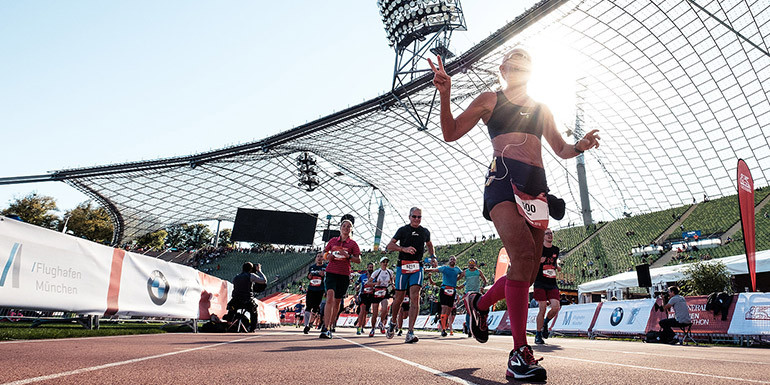
But there was another marathon last month, this time in Germany and a lesser-known American runner was among the pack. I was fortunate enough to have the opportunity to race the 2021 Munich Marathon, finishing in a personal-best time of 3:31:18. While this is a far cry from Galen Rupp’s battle in Chicago, I took seven minutes off my old PR and learned a few more lessons about racing in the process.
Munich was my third marathon, the other two being the Cape Cod Marathon in Falmouth, Massachusetts, and the Little Apple Marathon in Manhattan, Kansas. Needless to say, the stage was much bigger last weekend. The Munich Marathon begins and ends in the center of the Olympic Stadium. As I started the race and sprinted out of the stadium where Frank Shorter won the 1972 Olympic Marathon and sparked the first wave of American distance runners – a wave my grandfather (2:25:30) was a part of – I felt a surge of adrenaline and, over the first few miles, my pace dropped well below the intended 7:45/mile.
My initial plan had been to run the first ten miles at 7:45, the next ten at 7:40, and then drop down to 7:30-7:35 for the last 10k. Instead, I allowed the hype of the race and the emotions of the city and its heritage to overcome me and, for the first ten miles, I averaged a 7:10 mile. Over the rest of the race, I slowly dropped the pace until the last few miles I averaged 9:30/mile. My average pace ended up being 8:03; about twenty-five seconds slower than planned.
I ran the 2021 Munich Marathon in the Atreyu Running Company’s carbon-plated racing shoe: The Artist. I had previously logged about twenty miles in the shoes, just breaking them in, so I knew they were relatively fast. It was clear that the team at Atreyu Running put time and effort into The Artist; the shoe performed well, but there were two things specifically I noticed about the shoe. First, my right shoe seemed like it was slipping a bit around mile 8 as if the laces had loosened after I started running. Second, while throughout the first half of the marathon I felt as if I was gliding, during the latter half of the race my feet felt like they were being slapped with meat grinders. While this could partially be a product of low mileage during the train-up (I only averaged 30-35 miles per week) I suspect The Artist is more of a half-marathon shoe. That is, at least, how I intend to treat it moving forward and plan to race my next marathon in something like Adidas’s Adizero Adios Pro or Saucony’s Endorphin Pro.
Speaking of mileage, I absolutely maintained a low volume throughout my training cycle. Conventional wisdom states that you should hit around 40-50 miles per week when training for a marathon. While I maintained a consistent mileage for most of my buildup, it ended up only being about 30-35 weekly miles for the two months leading up to the race. I was able to max out my long run at 19 miles, but all-in-all I didn’t have enough mileage throughout the week. Moving forward, improving my weekly mileage should help in the later miles of the race.
During my 2020 buildup, I had about the same weekly mileage, but I was also lifting regularly throughout the training cycle. I squatted and deadlifted, in addition to other accessory lifts, twice a week, which greatly benefitted my ability to grind out the last six-eight miles of the Little Apple Marathon. I’ve written about the benefits of strength training for runners before but suffice it to say I failed to follow my own advice training for the 2021 Munich Marathon. I simply did not have the time or energy to get in the gym as much this year, and it showed in the last 10K.
Another major change I made was the decision not to carry a water bottle with me. This was clearly a mistake. I had forgotten what a mess water stations can be, not to mention how difficult it is to drink out of a cup while running without getting 80% of the water on your face, shirt, and up your nose. It’s not that much more difficult to just run with a bottle either in your hand or on an athletic belt. In the past, I’ve used Nathan’s Trailmix Plus hydration belt, but any bottle you feel comfortable carrying for most of the race will work. Eventually, I stopped trying to get water from the water stations and I probably was underhydrated most of the race. I won’t make that mistake again, and neither should you!
Overall, the 2021 Munich Marathon wasn’t a bad race. It was orchestrated well, the team took great care to ensure the runners were taken care of, the course clearly marked, and common-sense Covid-19 precautions enforced. I made quite a few blunders – some of them rookie mistakes – but at the end of the day I learned a great deal from them and I have quite a few more marathons left in me to improve. I still dropped seven minutes and a PR is a PR, no matter how ugly. The race left me beat down and exhausted, but craving more and I can’t wait to run my next 26.2.
If you liked this article, check out: What the 2021 Olympic Marathon says (and doesn’t say) about the Future of American Marathoners